Short Answer
In the realm of gemology and mineralogy, black gemstones are often prized not only for their aesthetic depth and sophistication but also for their historical associations with stability and shielding. While scientific gemology focuses on chemical composition and crystal structure, the study of these stones often intersects with cultural beliefs regarding “grounding”—the process of establishing a firm emotional and physical connection to the earth—and “protection,” the act of warding off negative influences.
Comparison Table
| Gemstone | Chemical Composition | Mohs Hardness | Luster | Primary Use |
|---|---|---|---|---|
| Black Tourmaline | Complex Borosilicate | 7.0 – 7.5 | Vitreous | Energetic Shielding |
| Obsidian | Volcanic Glass (SiO2) | 5.0 – 5.5 | Vitreous to Waxy | Psychological Insight |
| Black Onyx | Chalcedony (SiO2) | 6.5 – 7.0 | Waxy to Vitreous | Emotional Stability |
| Hematite | Iron Oxide (Fe2O3) | 5.5 – 6.5 | Metallic | Physical Grounding |
Shared Features
Despite their differing chemical origins, these gemstones share several key characteristics that make them suitable for grounding and protection purposes:
- Light Absorption: Their deep black coloration is a result of high concentrations of transition metals or specific crystal structures that absorb most visible light, symbolizing a “void” or a shield.
- Visual Weight: The perceived density of black stones provides a psychological sense of stability and permanence.
- Availability: Most of these minerals are abundant in the earth’s crust, making them accessible for both jewelry and larger decorative installations.
Important Differences
The primary differences lie in their geological formation and physical durability, which dictate how they interact with the wearer and the environment.
Crystalline vs. Amorphous
Black Tourmaline and Black Onyx are crystalline structures. Tourmaline is a complex silicate, while Onyx is a microcrystalline variety of quartz. In contrast, Obsidian is an amorphous volcanic glass; it lacks a crystal lattice, which is why it exhibits conchoidal fracture (curved, glass-like breaks).

Metallic vs. Non-Metallic
Hematite stands apart due to its high iron content, giving it a distinct metallic luster and a significantly higher specific gravity (density) than the other three stones. This physical weight is often cited as the reason for its superior “grounding” feel.
Expert Tip: When distinguishing between Black Onyx and Black Tourmaline, look for the “striations.” Tourmaline often shows vertical grooves along its length, whereas Onyx is typically smooth or shows parallel bands of color.
Suitability by Use
Choosing the right black gemstone depends on the specific goal of the user:
- For Intense Protection: Black Tourmaline is the industry standard due to its pyroelectric and piezoelectric properties, which some believe allow it to repel electromagnetic smog.
- For Emotional Strength: Black Onyx is preferred for long-term wear in jewelry, as its hardness makes it resistant to scratches during daily activity.
- For Rapid Grounding: Hematite is the most effective for those seeking a physical sensation of weight and connection to the earth.
- For Introspective Work: Obsidian is used primarily for “shadow work” or uncovering hidden truths, though its fragility makes it less suitable for rings.
Identification Limits
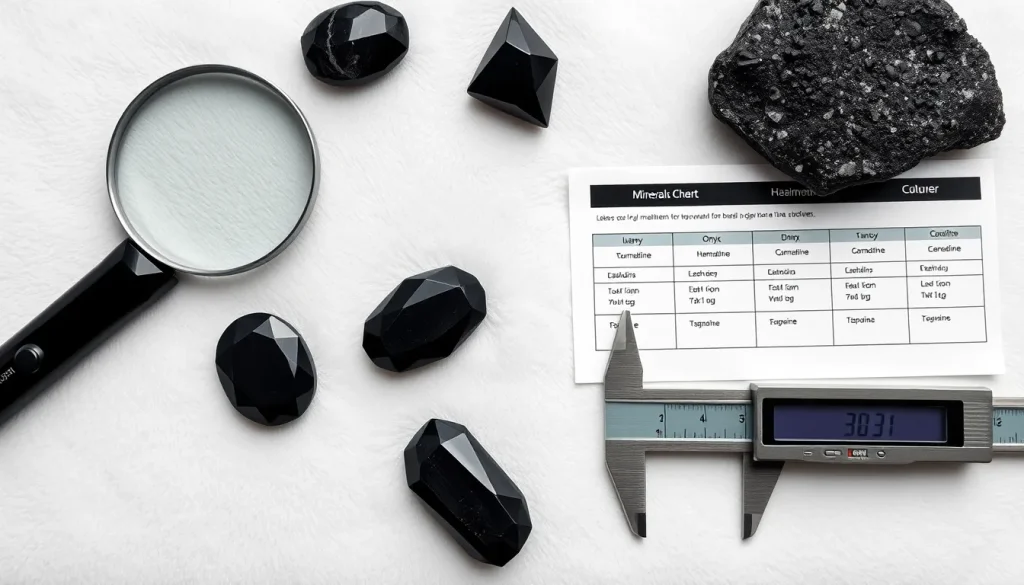
Identifying black gemstones can be challenging because many look identical to the naked eye. A common mistake is misidentifying Black Spinel or Black Diamond as Onyx. To differentiate, gemologists use Refractive Index (RI) testing and Specific Gravity (SG) measurements. For example, Hematite is significantly heavier than Obsidian, even if they share a similar dark hue.
Related Profiles
For those interested in grounding stones, it is recommended to explore profiles on Smoky Quartz, Red Jasper, and Labradorite, which offer complementary properties to the black gemstones discussed here.
FAQ
Which black gemstone is best for jewelry?
Black Onyx is generally the best for jewelry due to its hardness (6.5-7 Mohs) and resistance to scratching compared to Obsidian.
Is Obsidian a real gemstone?
Yes, although it is a volcanic glass (mineraloid) rather than a crystalline mineral, it is widely classified and traded as a gemstone.
How can I tell the difference between Hematite and Onyx?
The easiest way is weight and luster; Hematite is significantly heavier and has a metallic sheen, while Onyx is lighter with a waxy or vitreous luster.
Leave a Reply