
Short Answer
Direct Answer
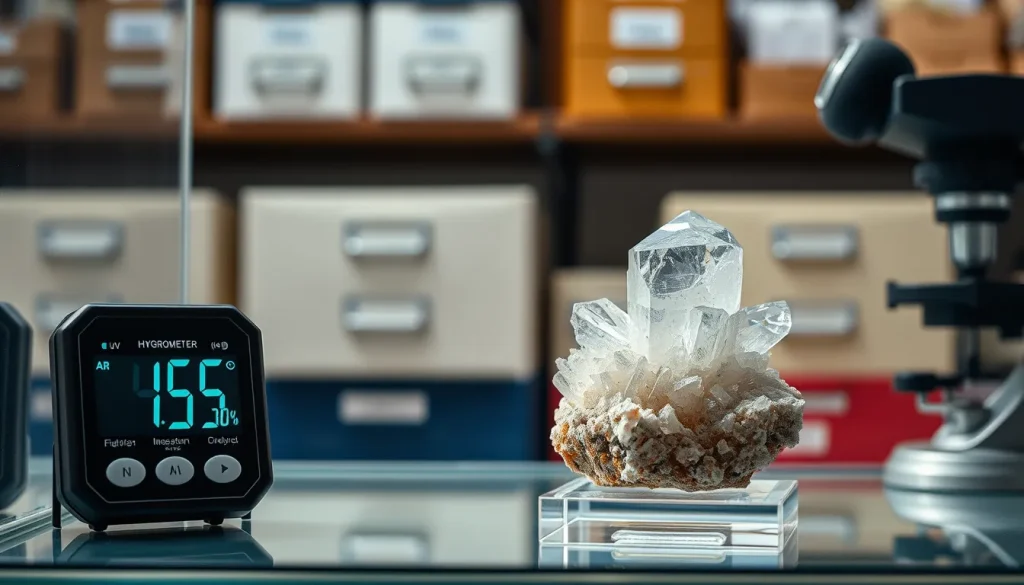
Storing and preserving fragile minerals is the practice of mitigating environmental and physical stressors to prevent the chemical degradation, physical fracturing, or discoloration of geological specimens. The core objective is to maintain the specimen in a state of stasis by controlling four primary variables: temperature, humidity, light exposure, and physical stability. For the serious collector, this involves transitioning from simple shelving to specialized archival environments that utilize inert materials and climate-controlled enclosures.
Relevant Conditions
Not all minerals are equally fragile; preservation strategies must be tailored to the specific vulnerabilities of the specimen. Collectors should be aware of the following critical conditions:
- Hygroscopic Sensitivity: Some minerals, such as Halite or certain evaporites, absorb moisture from the air, leading to dissolution or “melting.”
- Photosensitivity: Minerals like Amethyst, Fluorite, and Rose Quartz can undergo “sun-bleaching,” where UV radiation alters the oxidation state of trace elements, causing the color to fade.
- Oxidation and Hydration: Pyrite can develop “pyrite disease” (oxidation) in high humidity, while some zeolites may dehydrate and crumble if kept in overly dry environments.
- Mechanical Fragility: Acicular (needle-like) crystals, such as Natrolite or certain Calcite varieties, are prone to snapping under their own weight or due to minor vibrations.
Expert Tip: Always check the Mohs hardness and cleavage of a mineral before selecting a storage container. A soft mineral (hardness < 3) requires significantly more cushioning than a hard silicate.
Recommended Steps
To ensure the long-term survival of a fragile collection, follow these professional preservation protocols:
1. Environmental Stabilization
Maintain a consistent environment to avoid thermal expansion and contraction. Use the following guidelines:
| Factor | Ideal Range/Action | Risk of Neglect |
|---|---|---|
| Temperature | 18°C to 22°C (64-72°F) | Thermal shock/cracking |
| Humidity | 30% to 50% RH (varies by species) | Efflorescence or oxidation |
| Lighting | LED (UV-filtered), low lux | Permanent decolorization |
2. Proper Mounting and Support
Avoid using adhesives that can leach chemicals into the mineral. Instead, use:
- Museum Wax (Microcrystalline): A pH-neutral, removable wax used to stabilize specimens on a base.
- Acrylic Armatures: Custom-fitted clear supports that distribute the weight of the specimen evenly.
- Acid-Free Foam: Polyethylene foam (e.g., Ethafoam) for transporting or storing highly fragile samples.
3. Archival Containment
Store specimens in containers that do not off-gas. Avoid PVC plastics, which release hydrochloric acid over time. Opt for Polypropylene or Polyethylene containers. For extremely sensitive minerals, use airtight glass jars with silica gel packets to regulate internal humidity.
Exceptions
Certain minerals require counter-intuitive care. For example, while most minerals benefit from dry air, some hydrated minerals may crack if the environment is too arid. Similarly, some organic gemstones (like Opal) require a specific level of hydration to prevent “crazing” (internal cracking), meaning they should not be stored in airtight, bone-dry desiccators.
When to Ask a Professional
Consult a professional conservator or senior gemologist in the following scenarios:
- Active Degradation: If you notice white powdery deposits (efflorescence) or crumbling on a specimen.
- Complex Cleaning: When a specimen requires chemical cleaning to remove calcite or iron stains; improper acids can permanently etch the surface.
- High-Value Mounting: When securing a museum-grade specimen that requires a custom-engineered support system to prevent structural collapse.
FAQ
Can I store my minerals in direct sunlight?
No. Many minerals are photosensitive. Prolonged exposure to UV rays can cause permanent fading of colors in specimens like amethyst and fluorite.
What is 'pyrite disease' and how do I stop it?
Pyrite disease is a chemical reaction where pyrite reacts with humidity and oxygen to form sulfuric acid and iron sulfates. It is managed by keeping the specimen in a low-humidity environment (below 40% RH).
Is it safe to use superglue to fix a broken mineral?
It is generally discouraged. Superglue (cyanoacrylate) can leave permanent residues and may react with the mineral. Use reversible, archival-grade adhesives or professional conservation resins.

Leave a Reply