Short Answer
Overview
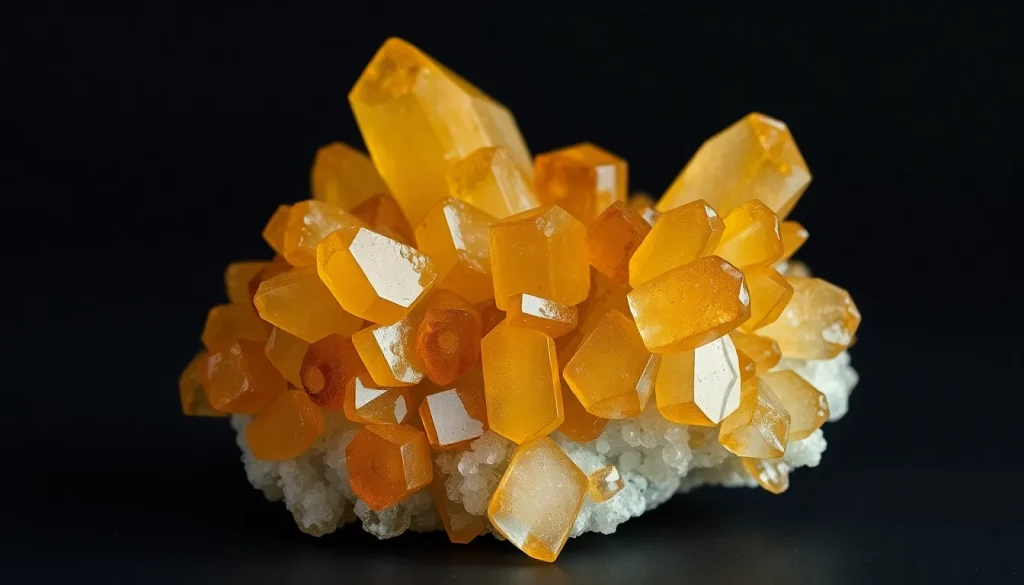
Beudantite is a secondary mineral of the alunite supergroup, chemically defined as PbFe3(AsO4)(SO4)(OH)6. It crystallises in the trigonal system and typically forms platy, tabular crystals or massive aggregates. The stone displays a range of warm colours from bright yellow and orange to brown‑gold, often with a vitreous to sub‑adamantine luster. Its hardness falls between 3.5 and 4.5 on the Mohs scale, making it relatively soft for use in jewelry.
History and Origin
The mineral was first described in 1845 from specimens collected in the Lengenbach Mine, Valais, Switzerland. It was named in honour of the French mineralogist Antoine-Beudant, who contributed extensively to early 19th‑century crystallography. Beudantite forms in the oxidized zones of lead‑arsenic ore deposits, commonly associated with minerals such as cerussite, galena, and arsenopyrite. Notable localities include Switzerland, Germany, the United Kingdom, the United States (Arizona), and several sites in Australia.
Meaning and Symbolism
In traditional gemstone lore, beudantite is associated with stability, protection, and grounding. Its earthy yellow‑brown palette is thought to echo the colours of the earth, encouraging a sense of security and perseverance. Collectors often value the stone for its rarity and distinctive crystal habit, seeing it as a symbol of perseverance through transformation.
Healing and Metaphysical Properties
Crystal‑healing practitioners attribute the following properties to beudantite, based on longstanding belief systems rather than scientific evidence:
- Grounding: Said to help anchor scattered energy and promote a feeling of rootedness.
- Protection: Believed to shield the aura from negative influences.
- Emotional Balance: Thought to assist in releasing fear and encouraging confidence.
- Physical Support: Traditional uses include supporting the digestive system and alleviating fatigue, though these claims are not medically verified.
These uses are rooted in folklore and should not replace professional medical advice.
Varieties and Types
Beudantite belongs to a small group of closely related minerals within the alunite supergroup, including:
- Pharmacosiderite: A calcium‑iron arsenate that shares similar crystal habits but differs in composition.
- Alunite: The calcium‑potassium analogue, typically colourless to pale green.
- Descloizite: A zinc‑lead vanadate that can appear in similar brownish tones.
While the chemical composition varies, the crystal symmetry and tabular habit remain consistent across the group.
Jewelry Uses and Care
Because beudantite is relatively soft (Mohs 3.5‑4.5) and exhibits perfect basal cleavage, it is best suited for pendants, earrings, and ornamental cabochons rather than rings or bracelets that endure heavy wear. The stone should be set in protective settings, such as bezel or bezel‑back designs, to reduce the risk of chipping.
Cleaning: Use lukewarm water with a mild, non‑abrasive soap. Gently brush with a soft nylon brush, avoiding ultrasonic cleaners or harsh chemicals that could alter surface luster.
Storage: Keep beudantite pieces separated from harder gemstones (e.g., quartz, sapphire) to prevent scratches. Store in a padded fabric pouch or a compartmentalised jewelry box.
Buying Guide
When purchasing beudantite, consider the following factors:
- Color Saturation: Deep, uniform yellow‑orange hues are most prized; uneven or overly brown specimens are less valuable.
- Crystal Quality: Well‑formed, tabular crystals with minimal surface weathering command higher prices.
- Origin: Specimens from classic localities such as Lengenbach (Switzerland) or the Arizona copper districts often carry a premium.
- Treatment Disclosure: Be aware of any heat or chemical treatments intended to enhance colour; reputable dealers will disclose this information.
- Certification: For larger cabochons or mineral specimens, request a gemological report from a recognized laboratory (e.g., GIA, IGI).
Because beudantite is a collector’s mineral rather than a mainstream gemstone, prices can vary widely based on size, clarity, and provenance.
FAQ
What is beudantite good for?
Beudantite is prized by collectors for its distinctive honey‑yellow crystals and is occasionally used in pendants and earrings. Traditional beliefs attribute grounding and protective energies to the stone.
Is beudantite rare?
High‑quality beudantite is relatively rare because it forms only in specific oxidized lead‑arsenic zones and requires well‑preserved crystal habit. Specimens from classic localities are especially scarce.
How can you tell if beudantite is real?
Authentic beudantite displays a yellow to brown colour, perfect basal cleavage, and a specific gravity around 4.5. A professional gemological lab can confirm its composition with X‑ray diffraction or spectroscopy.
What chakra is beudantite associated with?
In crystal‑healing traditions, beudantite is linked to the Root (Muladhara) chakra, reflecting its grounding symbolism.
How should you clean beudantite?
Clean beudantite with lukewarm water and mild soap, using a soft brush. Avoid ultrasonic cleaners, harsh chemicals, and high‑temperature heat, as the stone is relatively soft and may be porous.
Leave a Reply