
Short Answer
In the realm of mineralogy, few environments are as prized by collectors and gemologists as the granitic pegmatite. These coarse-grained igneous rocks act as nature’s concentrated laboratories, producing crystals of extraordinary size and purity that are rarely found in any other geological setting.
Definition
A granitic pegmatite is an extreme variety of igneous rock characterized by exceptionally large crystals, often exceeding several centimeters and sometimes reaching several meters in length. Chemically, they are similar to granite—composed primarily of quartz, feldspar, and mica—but they differ fundamentally in their crystallization process and their ability to concentrate rare elements (incompatible elements) that do not fit into the crystal lattices of common rock-forming minerals.
Plain-English Explanation
Imagine a large body of molten rock (magma) cooling slowly deep underground. As most of the magma freezes into solid granite, the remaining liquid becomes a “concentrated soup” of water, volatiles (like fluorine and boron), and rare elements that were pushed out of the earlier crystals. This leftover fluid is highly mobile and under immense pressure. When it finally finds a crack or pocket in the surrounding rock, it cools very slowly. Because the fluid is so rich in water, atoms can move quickly to the growing crystal faces, allowing gemstones to grow to massive proportions without the interference of competing crystals.
Example
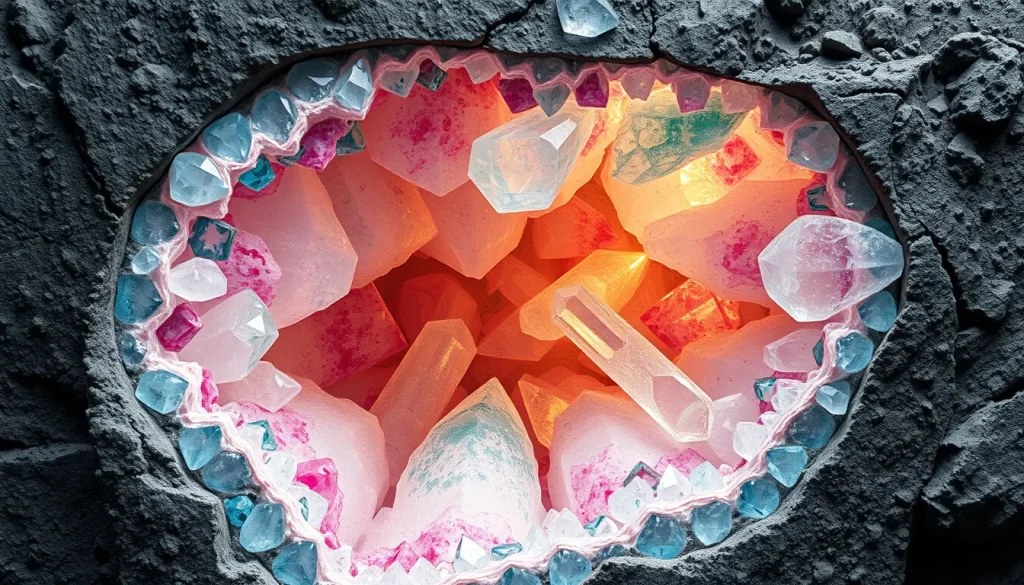
One of the most famous examples of pegmatite gemstone production can be found in the Minas Gerais region of Brazil. Here, granitic pegmatites have yielded world-class specimens of Tourmaline, Aquamarine, and Morganite. In these deposits, it is common to find “pockets”—hollow cavities lined with crystals—where gemstones grew undisturbed into the open space, resulting in the high clarity and perfect crystal faces sought by professional collectors.
Why It Matters
Understanding pegmatites is critical for gemologists and miners for several reasons:
- Concentration of Rarity: Elements like Lithium, Beryllium, and Boron are rare in the Earth’s crust. Pegmatites are the primary mechanism that concentrates these elements into minerals like Spodumene and Beryl.
- Crystal Quality: The slow cooling rate and presence of volatile fluids allow for the growth of large, gem-quality crystals with fewer inclusions than those formed in volcanic or metamorphic environments.
- Predictive Mining: By identifying the “zonation” of a pegmatite (the way minerals are arranged in layers), miners can predict where the most valuable gemstones are likely to be located within a deposit.
Gemologist’s Tip: When evaluating a stone from a pegmatite source, look for “zoning” or color changes within a single crystal. This often reflects the changing chemistry of the magma pocket as the gemstone grew over thousands of years.
FAQ
Why are pegmatite crystals so much larger than normal granite crystals?
The presence of water and other volatiles reduces the viscosity of the melt, allowing ions to migrate more quickly to the growth sites of the crystals.
Can diamonds be found in granitic pegmatites?
No. Diamonds form under extreme pressure in the Earth's mantle (kimberlites), whereas pegmatites form in the crust at much lower pressures.
What are 'pockets' in pegmatites?
Pockets are open cavities where crystals grew into a fluid-filled space rather than being crowded by other minerals, often leading to the highest quality gemstones.
Leave a Reply