
Short Answer
Overview
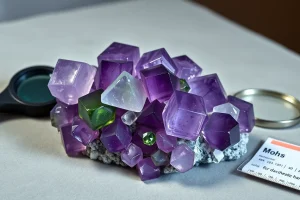
Lepidolite is a member of the mica group, distinguished by its lithium‑rich composition and delicate violet to pink coloration. The hue originates from trace amounts of lithium and manganese incorporated into the crystal lattice. Crystallographically, lepidolite forms in the monoclinic system as thin, flexible sheets that exhibit perfect basal cleavage. Its luster ranges from vitreous on fresh surfaces to pearly on cleavage planes, and it typically appears translucent to opaque. With a Mohs hardness of 2.5–3.5, lepidolite is relatively soft, limiting its use to jewelry pieces that are protected from abrasion, such as pendants, earrings, and brooches.
History and Origin
The name lepidolite derives from the Greek word lepis meaning “scale,” a reference to the mineral’s characteristic scaly habit. The species was first described in the early 19th century from deposits near Rio Grande do Sul, Brazil. Historically, lepidolite was mined primarily as a source of lithium for glass and ceramic production. Its attractive coloration soon attracted artisans, and small carved objects and ornamental mosaics appeared in European markets during the late 1800s. In the 20th century, the stone gained popularity among collectors and crystal‑healing enthusiasts, who prized its calming color and alleged energetic properties.
Meaning and Symbolism
In traditional gemstone lore, lepidolite symbolizes calmness, emotional balance, and inner peace. The gentle lavender and rose tones are thought to soothe nervous tension and encourage introspection. Some modern interpretations also connect lepidolite to transformation, reflecting lithium’s role in contemporary battery technology and the stone’s ability to shift from a muted to a vivid hue when exposed to light. While these meanings are rooted in cultural belief, they contribute to the stone’s appeal as a talisman for those seeking emotional stability.
Healing and Metaphysical Properties
Crystal‑healing practitioners attribute a range of soothing effects to lepidolite. It is said to ease anxiety, promote restful sleep, and assist in releasing old emotional patterns. The stone is believed to balance the heart and mind, fostering a sense of acceptance and self‑compassion. These properties are considered part of traditional metaphysical systems and are not intended as medical advice. Individuals interested in lepidolite’s reputed benefits typically use it in meditation, place it on the body, or keep it in a personal space.
Varieties and Types
Lepidolite occurs in several color varieties, each influenced by trace element chemistry:
- Lavender / Lilac: The most common variety, displaying soft violet hues due to lithium and manganese.
- Rose / Pink: Pale to medium pink shades, often intensified by higher manganese content.
- Greenish‑Gray: A rarer form where iron or other impurities shift the coloration toward gray‑green.
- Chatoyant Pearls: Certain cabochons exhibit a subtle cat‑eye effect when cut with a convex dome.
All varieties share the same basic chemical formula, but variations in trace elements affect hue intensity and transparency. Specimens may also display a silky, sheet‑like texture that is prized for mosaic work.
Jewelry Uses and Care
Because of its low hardness, lepidolite is best suited for jewelry that does not endure heavy wear. Popular settings include:
- Bezel or cushion settings that protect the edges.
- Faceted cabochons that highlight the stone’s pearly luster.
- Sheet fragments used in inlay work or decorative mosaics.
Care recommendations:
- Wipe gently with a soft, lint‑free cloth after each wear.
- For deeper cleaning, use mild soap and lukewarm water; avoid ultrasonic cleaners.
- Store lepidolite separately from harder gemstones to prevent scratching.
- Keep away from prolonged heat, strong acids, or alkaline solutions, which can alter the surface color.
Buying Guide
When selecting lepidolite, consider the following criteria to ensure quality and value:
- Color Saturation: Deep, even lavender or pink hues are most prized; pale or uneven coloration lowers value.
- Clarity: Look for minimal surface fissures; internal inclusions are common but should not dominate the surface.
- Cut and Shape: Cabochons bring out the stone’s luster, while thin sheets are valued for decorative mosaics.
- Origin: Brazilian lepidolite is widely available; specimens from North Carolina, Canada, or Madagascar may carry a premium due to rarity.
- Treatment Disclosure: Some stones are heat‑treated to enhance color; reputable sellers will disclose any treatments.
Ask for a gemological certificate from a recognized laboratory (e.g., GIA, IGI) when purchasing high‑value pieces. Verify that the seller provides clear return policies and provenance documentation.
FAQ
What is lepidolite good for?
Lepidolite is valued for its soothing lavender‑pink color in jewelry and decorative objects, and traditionally believed to promote calmness and emotional balance in crystal‑healing practices.
Is lepidolite rare?
High‑quality, vivid‑colored lepidolite is less common than many other micas, but the mineral itself is relatively abundant in lithium‑rich pegmatites worldwide.
How can you tell if lepidolite is real?
Authentic lepidolite displays perfect basal cleavage, a pearly to vitreous luster, and a Mohs hardness of 2.5–3.5. Professional testing such as refractive index measurement or X‑ray diffraction can confirm its identity.
What chakra is lepidolite associated with?
In crystal‑healing belief systems, lepidolite is most often linked to the Crown Chakra, with secondary associations to the Third Eye Chakra.
How should you clean lepidolite?
Clean lepidolite with a soft, lint‑free cloth and mild soap and lukewarm water; avoid ultrasonic cleaners, harsh chemicals, and high heat. Store it separately from harder gemstones to prevent scratching.
Leave a Reply