
Short Answer
Overview
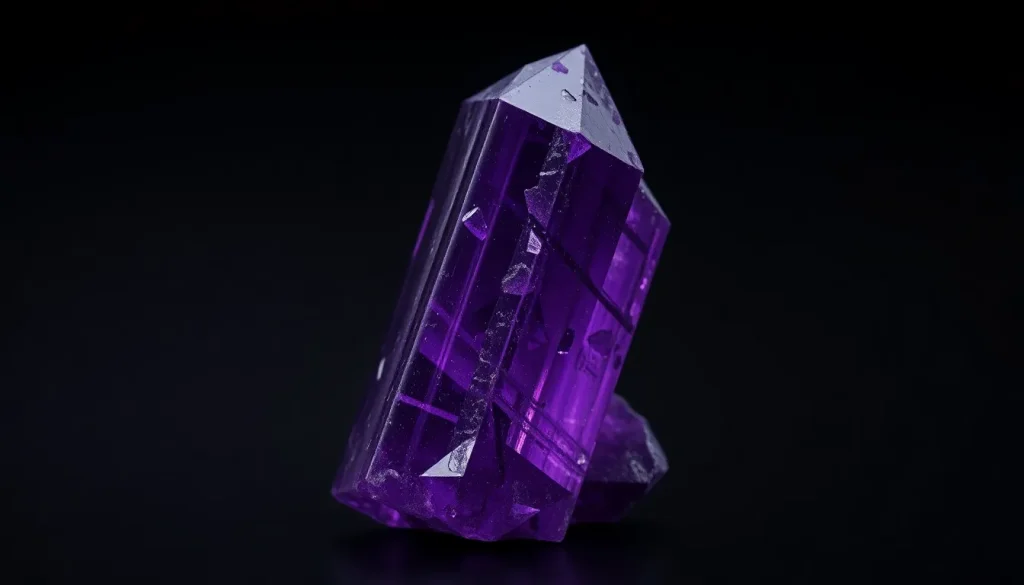
Magnesioaxinite is a member of the axinite group of sorosilicate minerals. Its ideal formula is Mg₂Al₄(BO₃)Si₄O₁₅, indicating that magnesium occupies the calcium sites found in other axinites. The mineral crystallises in the triclinic system and typically forms prismatic to tabular crystals with a vitreous luster. Colour ranges from deep violet‑purple to reddish‑brown, often displaying pleochroism.
History and Origin
The species was first described in 1971 from specimens collected in the Minas Gerais state of Brazil. The name combines “magnesio‑” to denote the dominant magnesium content and “axinite,” the group to which it belongs. Since its discovery, magnesioaxinite has been reported from a limited number of localities, including Brazil, Madagascar, the Ural region of Russia, and some occurrences in California, USA.
Meaning and Symbolism
In gemstone lore, magnesioaxinite is said to represent inner vision and personal transformation. Its violet hues are associated with creativity, intuition, and the ability to see beyond ordinary perception. Collectors often view it as a symbol of resilience because the mineral forms under relatively high‑pressure geological conditions.
Healing and Metaphysical Properties
Traditional crystal‑healing beliefs attribute the following effects to magnesioaxinite:
- Enhances psychic awareness and aids meditation.
- Supports emotional balance by soothing anxiety and stress.
- Promotes clarity in decision‑making and helps release old patterns.
These properties are based on cultural and metaphysical traditions and are not validated by medical science.
Varieties and Types
Magnesioaxinite belongs to the axinite group, which also includes axinite‑(Fe), axinite‑(Mn), and axinite‑(Ca). The primary distinction among them is the dominant cation occupying the A‑site of the structure (Fe²⁺, Mn²⁺, Ca²⁺, or Mg²⁺). While all share similar crystal habits and birefringence, colour variations arise from the differing cations and trace impurities.
Jewelry Uses and Care
Because of its moderate hardness (6.5–7 on the Mohs scale) and perfect cleavage on {010}, magnesioaxinite is used sparingly in jewelry. It is most often cut as a cabochon or a shallow facet to minimise risk of cleavage. When set in rings or pendants, protective settings such as bezel or channel settings are recommended.
Care instructions:
- Clean with a soft, lint‑free cloth; mild warm soapy water may be used.
- Avoid ultrasonic cleaners and steam cleaning, which can aggravate cleavage planes.
- Store separately from harder gemstones to prevent scratching.
Buying Guide
When purchasing magnesioaxinite, consider the following factors:
- Colour intensity: Deep, evenly saturated violet or purple hues are most desirable.
- Clarity: Inclusions are common; a clean interior enhances value.
- Cut quality: Look for well‑oriented cuts that respect the mineral’s cleavage.
- Origin: Specimens from Brazil and Madagascar are generally regarded as high‑quality.
- Treatment disclosure: Ensure the seller confirms the stone is untreated, as heating can alter colour.
Obtaining a certification from a reputable gemological laboratory (e.g., GIA or IGI) provides additional assurance of authenticity.
FAQ
What is magnesioaxinite good for?
Magnesioaxinite is valued by collectors for its vivid violet colour and distinctive crystal habit. In crystal‑healing traditions it is believed to enhance intuition and emotional balance, though these claims are not scientifically proven.
Is magnesioaxinite rare?
High‑quality magnesioaxinite is relatively rare because it forms in limited localities and is often small. Large, clear, intensely coloured specimens are especially scarce, making them more valuable.
How can you tell if magnesioaxinite is real?
Authentic magnesioaxinite shows a triclinic crystal habit, perfect cleavage on {010}, and a refractive index in the 1.73–1.75 range. Professional gemological testing, such as a refractometer reading and X‑ray diffraction, provides definitive identification.
What chakra is magnesioaxinite associated with?
Traditional crystal lore links magnesioaxinite to the Third Eye (Ajna) chakra, reflecting its deep violet hue and association with intuition.
How should you clean magnesioaxinite?
Clean gently with a soft lint‑free cloth and mild warm soapy water. Avoid ultrasonic or steam cleaners, and store the stone separately from harder gems to prevent scratching.
Leave a Reply