
Short Answer
Overview
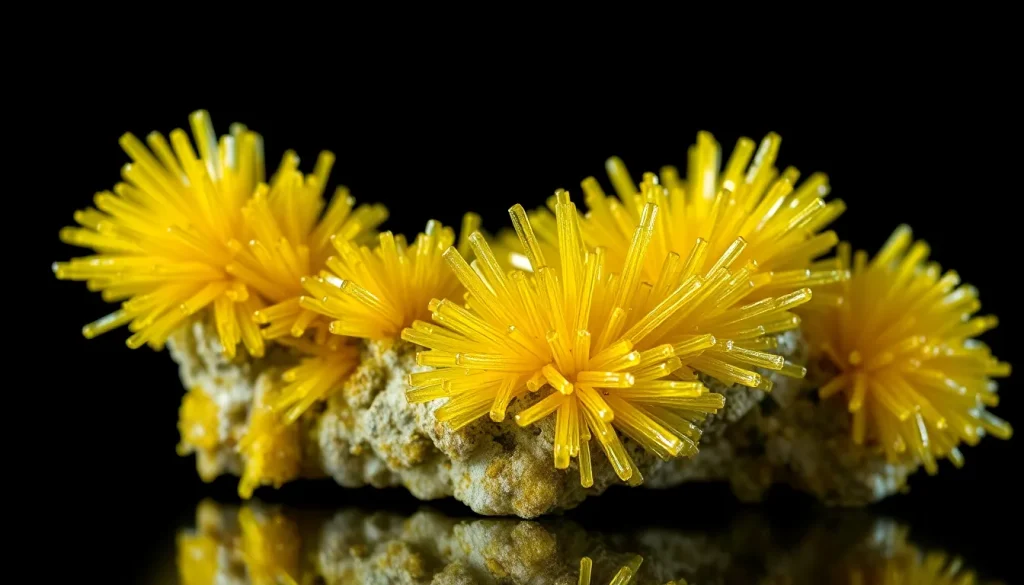
Millerite is a nickel sulfide mineral (chemical formula NiS) noted for its bright brass‑yellow to golden color and distinctive metallic luster. It crystallizes in the isometric (cubic) system, often forming acicular (needle‑like) aggregates that can resemble tiny spikes or radiating clusters. While primarily of interest to mineral collectors, Millerite is occasionally cut as a novelty gemstone for jewelry, especially in pieces that highlight its reflective surface.
History and Origin
The mineral was first described in 1845 by the German mineralogist Wilhelm Haidinger and named after the British mineralogist William Miller, who contributed to early studies of nickel ores. Natural occurrences have been recorded in sulfide‑rich zones of nickel deposits worldwide. Notable historic localities include the Sudbury Basin in Ontario, Canada; the Ural Mountains of Russia; and the Bisbee district of Arizona, USA. Modern mining continues in these regions, often as a by‑product of nickel extraction.
Meaning and Symbolism
In traditional gemstone lore, Millerite’s golden hue is associated with wealth, abundance, and the sun’s vitality. Its metallic sheen is thought to symbolize strength, resilience, and the ability to reflect inner truth. Some cultures view the stone as a talisman for attracting prosperity and enhancing personal confidence.
Healing and Metaphysical Properties
Crystal‑healing practitioners attribute several metaphysical qualities to Millerite. It is believed to promote grounding, emotional balance, and the release of negative patterns. The stone is said to assist in aligning the solar plexus chakra, encouraging personal power and self‑esteem. As with all crystal work, these claims are based on tradition and should not replace professional medical advice.
Varieties and Types
While Millerite itself is a single mineral species, variations can occur in color intensity and crystal habit:
- Golden Millerite – The most common form, displaying a bright brass‑yellow to golden color.
- Pale Millerite – Light‑yellow or almost whitish specimens, often found in fine‑grained matrix.
- Altered Millerite – Specimens that have undergone surface oxidation, developing a duller appearance or a thin tarnish.
All varieties retain the same chemical composition (NiS) and share the same physical properties.
Jewelry Uses and Care
Because Millerite ranks between 3.5 and 4.5 on the Mohs hardness scale, it is relatively soft compared with traditional gemstones such as quartz or sapphire. Consequently, it is best suited for:
- pendants and lockets where the stone can be displayed but not subjected to frequent impact,
- earrings with protective bezels, and
- brooches or decorative pieces that are handled gently.
Care recommendations:
- Avoid exposure to harsh chemicals, acids, or chlorine, which can discolor the metallic surface.
- Clean with a soft, lint‑free cloth; mild warm soapy water may be used if necessary, followed by thorough drying.
- Store separately from harder gemstones to prevent scratching.
- Because Millerite can be brittle along certain cleavage planes, handle with care and avoid dropping.
Buying Guide
When purchasing Millerite, consider the following factors:
- Color Saturation: Deep, uniform golden tones are most desirable.
- Crystal Form: Well‑defined acicular aggregates or single crystals display higher aesthetic value.
- Clarity: Look for specimens free of heavy surface tarnish or excessive inclusions that obscure the luster.
- Cut and Setting: Because the stone is opaque, cutting focuses on preserving shape and maximizing reflective surfaces. Settings that protect the stone’s edges are preferred.
- Certification: Request a gemological report from a reputable laboratory if the piece is marketed as a “gem‑grade” Millerite.
Prices vary widely based on size, color intensity, and provenance. Expect higher costs for large, well‑formed crystals from renowned localities such as Sudbury or the Ural Mountains.
FAQ
What is Millerite good for?
Millerite is valued for its striking golden metallic appearance in specialty jewelry and as a collector's mineral. Traditional beliefs also associate it with prosperity, grounding, and confidence, though these are not scientifically proven.
Is Millerite rare?
Millerite is not among the rarest minerals, but gem‑grade, well‑formed, brightly colored specimens are less common. High‑quality material from classic localities such as Sudbury or the Ural Mountains is considered comparatively rare.
How can you tell if Millerite is real?
Real Millerite exhibits a metallic luster, brass‑yellow color, and a black streak. It is opaque and typically forms needle‑like aggregates. Professional testing, such as X‑ray diffraction or a certified gemological report, provides definitive verification.
What chakra is Millerite associated with?
In crystal‑healing traditions Millerite is sometimes linked to the solar plexus chakra for personal power, but there is no universally accepted chakra assignment.
How should you clean Millerite?
Use a soft, lint‑free cloth to gently wipe the surface. If needed, clean with warm soapy water, rinse, and dry thoroughly. Avoid ultrasonic cleaners, harsh chemicals, and abrasive materials, as the stone is relatively soft and can be scratched.
Leave a Reply