
Short Answer
Overview
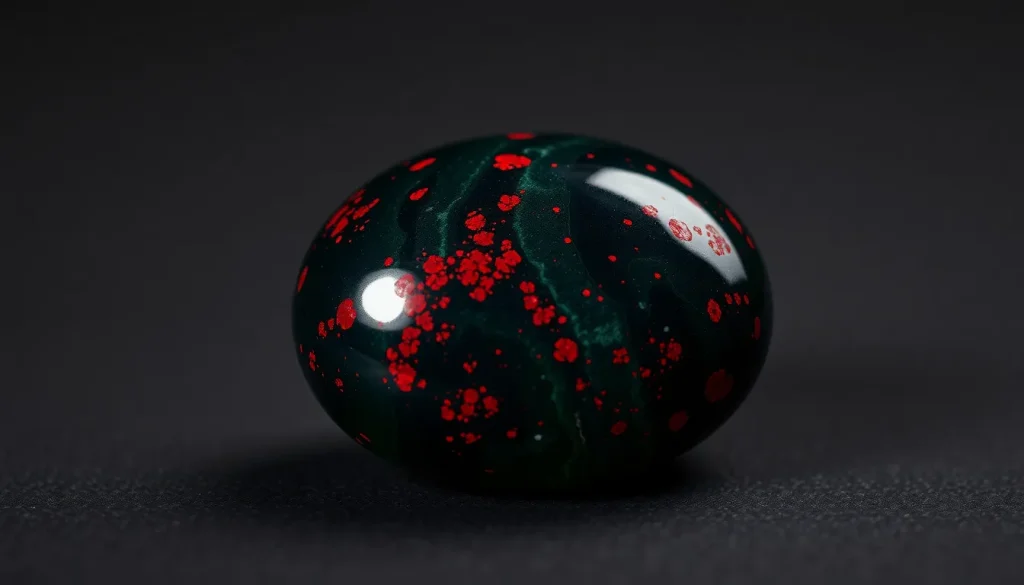
Bloodstone, also known as heliotrope, is a dark green variety of chalcedony (microcrystalline quartz) that contains distinctive red specks of hematite. The green matrix is caused by minute amounts of iron, while the red inclusions are iron oxide crystals that give the stone its name. Chemically, the stone is primarily silicon dioxide (SiO₂) and belongs to the quartz family.
History and Origin
The name “heliotrope” derives from the Greek words helios (sun) and tropos (turn), referring to an ancient belief that the stone turned toward the sun. Historical records show bloodstone being used in ancient Egypt, Greece, and Rome for seals, amulets, and signet rings. The most famous historic source is the ancient Indian mines of the Deccan Plateau, especially the region of Madhya Pradesh, which continues to produce high‑quality material today. Other notable localities include Brazil, the United States (Oregon), Australia, and China.
Meaning and Symbolism
Across cultures, bloodstone has been associated with courage, vitality, and protection. In medieval Europe it was believed to staunch bleeding and to grant the wearer invincibility in battle. In folklore, the red spots were thought to be drops of the stone’s own “blood,” symbolizing life force and renewal.
Healing and Metaphysical Properties
Traditional crystal‑healing beliefs attribute the following properties to bloodstone:
- Grounding and courage: It is said to strengthen the wearer’s resolve and aid in overcoming fear.
- Physical vitality: Some practitioners claim it supports the circulatory system and helps with minor wounds, though these are not medical facts.
- Emotional balance: The stone is thought to promote emotional clarity and assist in releasing old emotional patterns.
These claims are rooted in tradition and should not replace professional medical advice.
Varieties and Types
Bloodstone is essentially a single variety of chalcedony, but minor differences exist based on origin and inclusion pattern:
- Indian Bloodstone: Typically dark green with dense, uniformly distributed red specks.
- Brazilian Bloodstone: Often exhibits larger, more irregular hematite inclusions and may show a slightly lighter green base.
- Oregon Bloodstone: Known for a higher proportion of translucent green, allowing light to penetrate the stone.
Jewelry Uses and Care
Because of its attractive color contrast and relative durability (Mohs 6.5–7), bloodstone is popular in rings, cabochons, beads, and cameos. It is commonly set in silver or gold, which complement its green hue.
Care instructions:
- Clean with warm, soapy water and a soft brush; avoid ultrasonic cleaners if the stone has been heat‑treated.
- Wipe with a lint‑free cloth after exposure to perfume, lotions, or chemicals.
- Store separately from harder gemstones (e.g., diamond, sapphire) to prevent scratching.
Buying Guide
When selecting bloodstone, consider the following factors:
- Color uniformity: Look for a deep, even green base with evenly distributed red inclusions. Overly pale green or excessive darkening may indicate heat treatment.
- Clarity: Natural hematite specks are desirable; however, large fractures or cloudiness reduce value.
- Cut and finish: High‑quality cabochons exhibit a smooth, polished surface that showcases the stone’s translucency.
- Origin labeling: Reputable dealers will disclose the source (e.g., India, Brazil). Provenance can affect both price and authenticity.
- Certification: For valuable pieces, request a gemological report from a recognized laboratory such as GIA or IGI.
Prices vary widely, with untreated, deep‑green specimens from historic Indian mines commanding the highest premiums.
FAQ
What is bloodstone good for?
Bloodstone is prized for its striking green‑with‑red appearance in jewelry, and traditionally it is believed to promote courage, grounding, and physical vitality in crystal‑healing practices.
Is bloodstone rare?
High‑quality, untreated bloodstone from historic Indian mines is relatively scarce and commands higher prices, while more common material from Brazil or the United States is more readily available.
How can you tell if bloodstone is real?
Real bloodstone feels cool to the touch, has a waxy‑to‑vitreous luster, and shows natural red hematite inclusions that are not uniform. Professional testing (e.g., refractive index measurement) confirms authenticity.
What chakra is bloodstone associated with?
In traditional crystal lore, bloodstone is linked to the Heart (Anahata) chakra, thought to support emotional balance and grounding.
How should you clean bloodstone?
Clean bloodstone with warm, soapy water and a soft brush, avoid harsh chemicals or ultrasonic cleaners if the stone has been heat‑treated, and store it separately from harder gemstones to prevent scratches.
Leave a Reply