
Short Answer
Overview
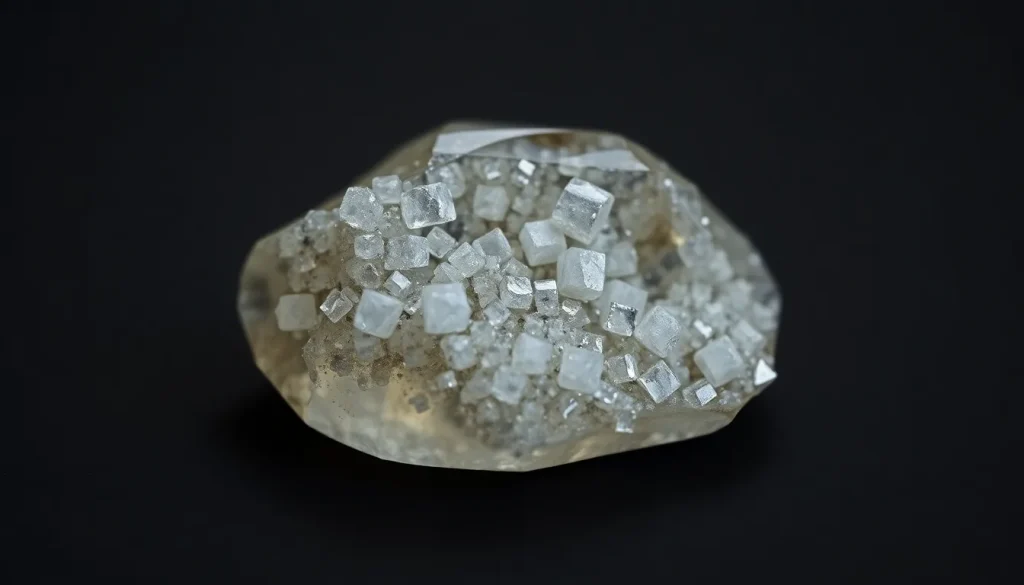
Senarmontite is the natural mineral form of antimony trioxide (Sb2O3). It crystallizes in the isometric (cubic) system, most often appearing as tiny cubic crystals, granular masses, or massive aggregates. The stone is characteristically white to colorless, occasionally displaying a faint yellow tint, and it possesses an adamantine to vitreous luster with a high refractive index.
History and Origin
The name “senarmontite” honors French mineralogist Charles‑François‑Pierre Senarmont (1798‑1881), who first described the mineral in the early 19th century. Historically, antimony compounds were used as pigments and cosmetics, but the crystalline form of senarmontite was primarily a collector’s specimen rather than an industrial material. Natural occurrences are recorded in several European localities, notably the French and Italian Alps, as well as in the Czech Republic and Russia. Modern discoveries include deposits in Canada and the United States (Colorado).
Meaning and Symbolism
In traditional gemstone lore, senmarontite is associated with clarity of thought and the purification of negative energies. Its bright, almost translucent appearance has led to beliefs that it can help “clear the mind” and promote honest communication. The stone is sometimes linked to personal transformation, symbolizing the transition from opacity to transparency.
Healing and Metaphysical Properties
Crystal‑healing practitioners attribute senmarontite with the following properties, described as traditional beliefs rather than medical facts:
- Emotional balance: Supports grounding and emotional steadiness during periods of stress.
- Mental clarity: Said to enhance focus, decision‑making, and the ability to see situations clearly.
- Protection: Believed to shield the aura from intrusive or destabilizing influences.
- Chakra work: Often associated with the Crown Chakra, though no single standard chakra is universally recognized for senmarontite.
These attributes are part of longstanding metaphysical traditions and should not replace professional medical advice.
Varieties and Types
Senarmontite is the cubic polymorph of antimony trioxide; its dimorph is valentinite, which crystallizes in the orthorhombic system. Both share the same chemical formula (Sb2O3) but differ in crystal habit. Specimens may be found as:
- Well‑formed cubes or octahedra (rare and highly valued by collectors).
- Massive granular aggregates, often used in ornamental carvings.
- Altered or weathered material where senarmontite has partially oxidized to other antimony oxides.
Jewelry Uses and Care
Because senmarontite ranks only 2.5–3 on the Mohs hardness scale, it is relatively soft and prone to scratching. Consequently, it is most commonly employed in pendants, earrings, and brooches where the stone can be set securely and protected from abrasion. When used in jewelry, the following care guidelines are recommended:
- Cleaning: Use a soft, lint‑free cloth and mild soap‑water solution. Avoid ultrasonic cleaners and steam cleaning, which can cause micro‑fractures.
- Storage: Keep pieces separately in a padded pouch or compartment to prevent contact with harder gemstones or metals.
- Avoid harsh chemicals: Acids, bleach, and strong detergents may alter the surface luster.
- Handling: Because the stone can cleave along no natural planes, treat it gently and avoid dropping.
Buying Guide
When selecting senmarontite, consider the following factors:
- Clarity and crystal form: Well‑formed cubes or octahedra are rarer and command higher prices than massive, granular material.
- Color: Pure white to colorless specimens are most sought after; any yellowing may indicate alteration.
- Cut and setting: Because the stone is soft, protective settings (bezel or prong with low profile) are preferred.
- Origin documentation: Reputable dealers should provide provenance, especially for larger or unusually clear specimens.
- Treatment disclosure: Natural senmarontite is rarely treated, but any enhancement (e.g., dyeing) must be disclosed.
Engage a certified gemologist for an independent appraisal if you are purchasing high‑value pieces or need verification of authenticity.
FAQ
What is senarmontite good for?
Senarmontite is mainly valued by collectors for its cubic crystal habit and high luster. Traditionally, it is believed to promote mental clarity and emotional grounding, though these are metaphysical attributes, not scientific facts.
Is senarmontite rare?
High‑quality, well‑formed senarmontite crystals are relatively rare, especially large specimens. The mineral itself occurs in several localities, but gem‑grade material is less common than many other oxides.
How can you tell if senarmontite is real?
Real senarmontite is identified by its cubic crystal form, white to colorless color, high specific gravity (~5.5), and a refractive index around 1.74. Professional gemological testing (e.g., spectroscopy or density measurement) is recommended for certainty.
What chakra is senarmontite associated with?
In crystal‑healing traditions senarmontite is sometimes linked to the Crown Chakra, though no single standard chakra association exists for this mineral.
How should you clean senarmontite?
Clean gently with a soft cloth and mild soapy water. Avoid ultrasonic cleaners, steam, and harsh chemicals. Store separately in a padded pouch to protect it from scratches.
Leave a Reply