
Short Answer
Definition
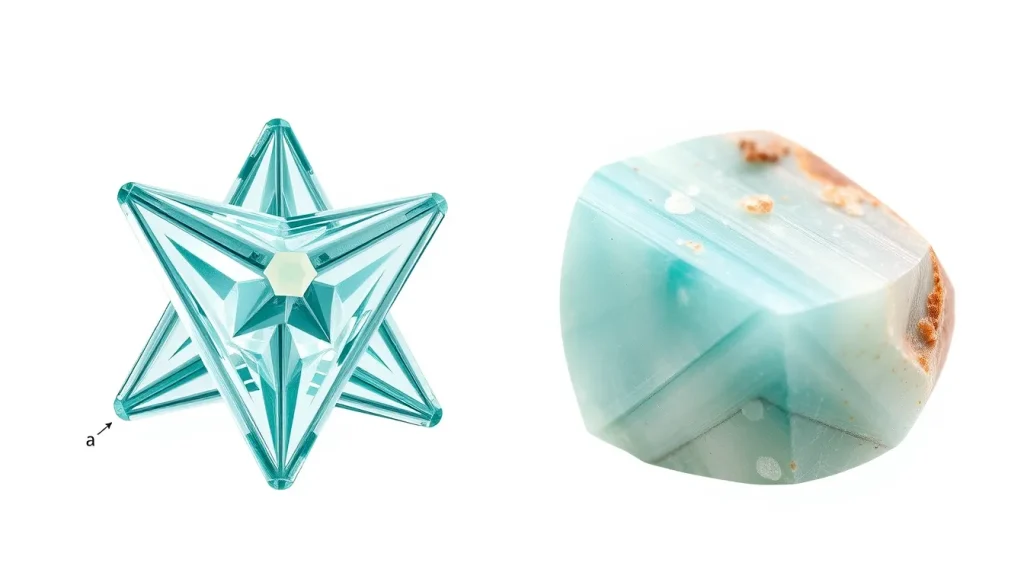
The triclinic crystal system is the least symmetrical of the seven crystal systems in mineralogy. In this system, the crystal lattice is defined by three axes of unequal length that intersect at oblique angles—none of which are 90 degrees. Because it lacks any rotational symmetry or mirror planes, it is often described as the most ‘irregular’ or ‘asymmetrical’ system in the natural world.
Plain-English Explanation
Imagine a rectangular box that has been pushed or skewed from every single direction. In most crystal systems, at least some of the sides are equal or the corners meet at perfect right angles (like a cube or a brick). In a triclinic crystal, however, nothing is square and nothing is equal. The three axes (the imaginary lines that define the crystal’s growth) are all different lengths, and the angles between them are all different and none are 90°. This results in crystals that often look skewed, slanted, or distorted to the naked eye.
Example
One of the most prominent examples of a gemstone belonging to the triclinic system is Amazonite (a variety of Microcline feldspar). While feldspars often form large masses, their internal atomic arrangement is triclinic. Another example is Kyyanite, which displays a distinct bladed habit and strong anisotropy, a direct result of its low-symmetry triclinic structure. Because of this asymmetry, these stones often exhibit different physical properties (like hardness or refractive index) depending on which direction the crystal is measured.
Why It Matters
For the gemologist and jewelry professional, understanding the triclinic system is crucial for several practical reasons:
- Optical Properties: Triclinic minerals are biaxial, meaning they have three different refractive indices. This leads to complex double refraction and distinct pleochroism.
- Cutting and Polishing: Because hardness varies significantly along different axes, a lapidary must be careful when cutting triclinic stones to avoid cleavage planes or unexpected fracturing.
- Identification: The lack of symmetry is a diagnostic tool. When a mineral lacks any mirror planes or axes of rotation, it narrows the identification process significantly toward the triclinic system.
The triclinic system represents the extreme end of the symmetry spectrum; where the cubic system is the height of order, the triclinic is the essence of asymmetry.
FAQ
Do triclinic crystals always look skewed?
While their internal structure is always skewed, the external form (habit) may not always be obvious to the naked eye, especially in massive or granular specimens.
Why is the triclinic system harder to cut?
Because the physical properties (like hardness) vary across the three unequal axes, the stone may respond differently to the grinding wheel depending on the orientation.
Is diamond triclinic?
No, diamond belongs to the cubic crystal system, which is the most symmetrical system.



Leave a Reply