Short Answer
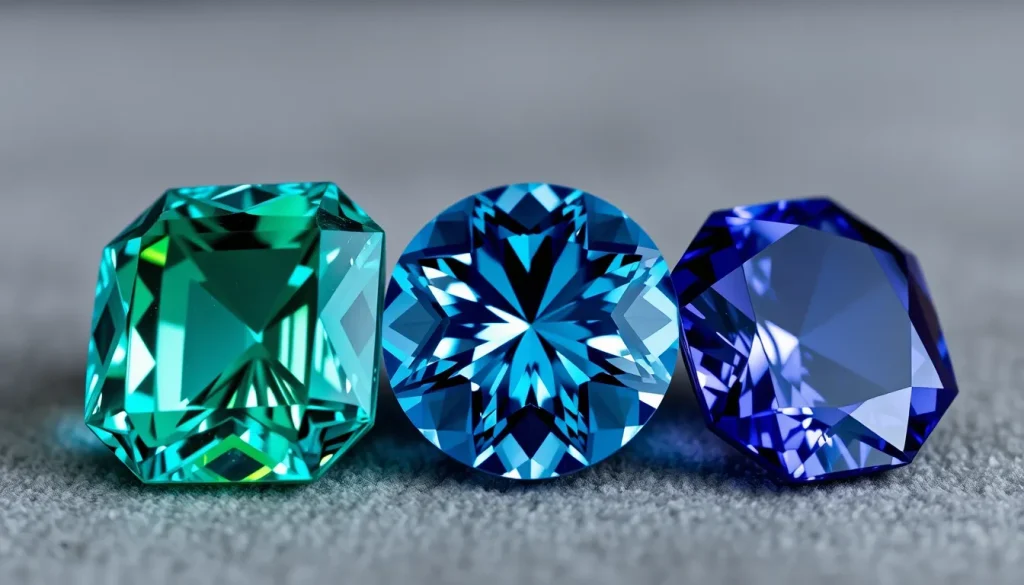
In the world of high jewelry, ‘neon’ is a term reserved for gemstones that possess an electric, saturated glow that appears to emanate from within the stone rather than merely reflecting external light. While many gemstones appear blue, Paraiba Tourmaline, Blue Zircon, and Tanzanite each offer a distinct version of this luminosity, driven by different chemical trace elements and crystal structures.
Comparison Table
| Feature | Paraiba Tourmaline | Blue Zircon | Tanzanite |
|---|---|---|---|
| Color Profile | Neon Electric Blue/Green | Bright Cyan to Deep Blue | Violet-Blue (Trichroic) |
| Hardness (Mohs) | 7.0 – 7.5 | 6.5 – 7.5 | 6.0 – 7.0 |
| Refractive Index | 1.61 – 1.64 | 1.92 – 1.98 (Very High) | 1.69 – 1.70 |
| Dispersion | Low to Moderate | Very High (Fire) | Moderate |
| Rarity | Extremely Rare | Moderate to Rare | Rare (Single Source) |
| Primary Cause of Color | Copper (Cu) | Niobium/Rare Earths | Vanadium (V) |
Shared Features
Despite their disparate mineralogical origins, these three gemstones are often grouped together by collectors seeking a high-saturation blue. They all share the following characteristics:
- High Demand: All three are prized for their ability to stand out in jewelry settings compared to traditional blue sapphires.
- Sensitivity to Light: While not as extreme as some gems, the quality of their color is heavily dependent on the light source (daylight vs. incandescent).
- Investment Potential: High-quality specimens of all three varieties have shown consistent value appreciation over the last decade.
Important Differences
The primary distinctions lie in their optical behavior and chemical makeup.
Optical Brilliance and Fire
Blue Zircon is the undisputed leader in terms of “fire” (dispersion). Due to its high refractive index, it breaks light into spectral colors similarly to a diamond. Paraiba Tourmaline, conversely, does not rely on fire but on saturation; its glow is a result of copper ions that create a specific wavelength of light that the human eye perceives as “electric.” Tanzanite is uniquely trichroic, meaning it can show blue, violet, and burgundy hues depending on the angle of observation.

Durability and Hardness
From a gemological standpoint, Paraiba and Zircon are slightly more durable than Tanzanite. Tanzanite’s lower Mohs hardness (6-7) makes it more susceptible to scratching and cleavage, requiring more caution during wear and setting.
Expert Tip: When distinguishing between these three, look at the “glow.” If the stone looks like it has a lightbulb inside it, it is likely a Paraiba. If it flashes like a diamond, it is likely a Blue Zircon. If it shifts from blue to purple, it is Tanzanite.
Suitability by Use
Choosing between these gems depends on the intended jewelry application:
- Engagement Rings: Blue Zircon is a viable choice due to its brilliance, though its tendency to chip requires a protective setting (e.g., bezel). Paraiba is the ultimate luxury choice for high-end bespoke rings.
- Statement Necklaces: Tanzanite is ideal for larger center stones because it can be found in larger crystals than Paraiba Tourmaline, providing a royal, deep-blue presence.
- Daily Wear: Paraiba Tourmaline offers the best balance of hardness and stability for rings, provided it is not exposed to harsh chemicals.
Identification Limits
To the untrained eye, a high-quality Blue Zircon can be mistaken for a Paraiba Tourmaline. However, a gemologist will use a refractometer to instantly tell them apart; Zircon’s refractive index is significantly higher than that of Tourmaline. Tanzanite is usually easier to identify due to its characteristic pleochroism (color shifting), which is not present in the same way in Paraiba or Zircon.
Related Profiles
For those interested in neon blues, we recommend exploring profiles on Aquamarine (for a softer blue), Blue Sapphire (for maximum durability), and Indicolite (the non-neon blue variety of tourmaline).
FAQ
Which is more expensive: Paraiba or Tanzanite?
Generally, Paraiba Tourmaline is significantly more expensive per carat than Tanzanite due to its extreme rarity and the unique copper-induced neon glow.
Is Blue Zircon the same as Cubic Zirconia?
No. Blue Zircon is a naturally occurring mineral, whereas Cubic Zirconia is a synthetic lab-created stimulant.
Can Tanzanite be worn every day?
Yes, but caution is advised. Because it is softer (6-7 Mohs), it should be protected from hard knocks and cleaned with mild soap and water only.
Leave a Reply