
Short Answer
Overview
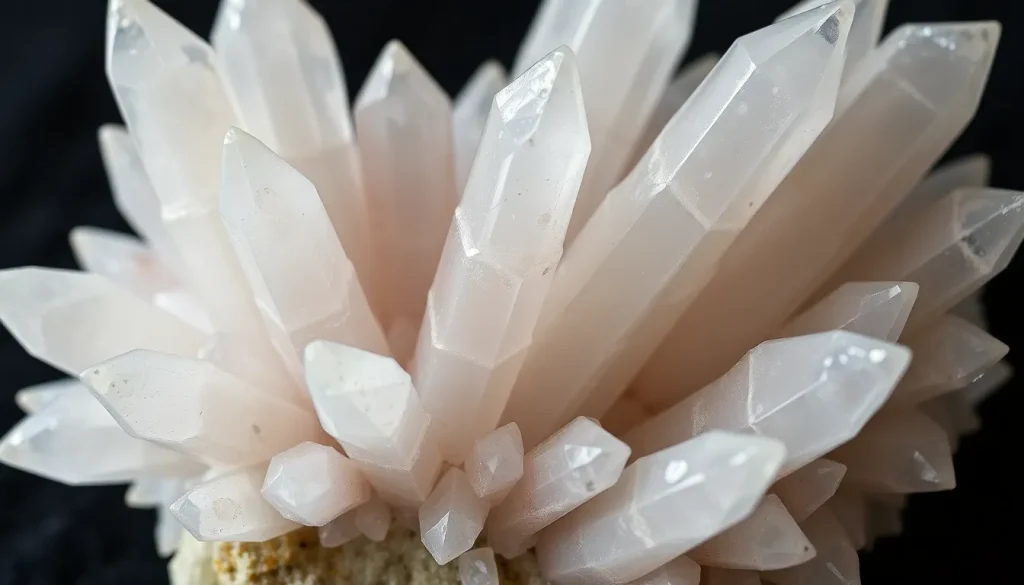
Stilbite is a member of the zeolite group of tectosilicate minerals. It commonly forms elongated, flattened, or fan‑shaped crystals with a characteristic “spear‑head” or “straw‑basket” habit. Colors range from colorless and white to pale yellow, pink, green, and brown. Although softer than many traditional gemstones (Mohs 4–5), stilbite is occasionally set in jewelry, especially in designs that showcase its unique crystal form.
History and Origin
The name “stilbite” derives from the Greek word stilbos, meaning “shining” or “glittering,” a reference to its vitreous luster. Stilbite was first described in the early 19th century from specimens found near the town of Stilb, in the former Kingdom of Prussia (now part of Poland). Since then, notable deposits have been identified in Japan, Canada (British Columbia), the United States (Idaho and Nevada), Italy, Turkey, and the Ural region of Russia. Historically, stilbite was collected more for scientific study than for adornment, but its attractive crystal shapes have earned it a place in modern gemstone collections.
Meaning and Symbolism
In traditional gemstone lore, stilbite is associated with grounding, stability, and the facilitation of personal transformation. It is thought to encourage clarity of thought and help the wearer align with their inner purpose. Because the mineral often occurs in layered, fan‑like formations, it is sometimes symbolically linked to the unfolding of potential and the opening of new pathways.
Healing and Metaphysical Properties
Crystal‑healing practitioners attribute several metaphysical qualities to stilbite. It is believed to assist in emotional balance, promote a sense of calm during stressful situations, and aid in the release of old patterns that no longer serve. Some claim that stilbite supports the root and sacral chakras, helping with issues of security, creativity, and personal power. These beliefs are part of traditional crystal lore and are not intended as medical advice.
Varieties and Types
Stilbite occurs in two major compositional varieties:
- Stilbite‑Ca – calcium‑rich, typically forming larger, more robust crystals.
- Stilbite‑Na – sodium‑rich, often displaying finer, more delicate crystal aggregates.
Color variations are caused by trace impurities and radiation exposure. Commonly, the mineral is found in colorless, white, or very light shades, but pink, green, and brown specimens are also reported.
Jewelry Uses and Care
Because of its relative softness and perfect basal cleavage, stilbite requires careful handling in jewelry. It is most suitable for pendants, earrings, and brooches where the stone can be protected from impact. Settings that cushion the stone, such as bezel or prong mounts with protective backings, are recommended.
Cleaning should be done with a soft, lint‑free cloth and mild soapy water. Avoid ultrasonic cleaners, steam, or harsh chemicals, as these can damage the crystal structure or leach water from the mineral’s channels.
Buying Guide
When purchasing stilbite, consider the following factors:
- Clarity and Inclusion – Look for stones with minimal fractures and clear, well‑defined crystal faces.
- Color Saturation – While many stilbites are pale, deeper, evenly distributed hues (e.g., pink or green) are rarer and may command higher prices.
- Cut and Setting – Choose pieces where the stone is securely set to protect its perfect cleavage.
- Origin Disclosure – Reputable dealers will provide provenance, especially for specimens from well‑known localities such as Japan or British Columbia.
- Treatment – Natural stilbite is seldom treated; however, confirm that the stone has not been dyed or stabilized, as these practices are sometimes employed to enhance color.
Because stilbite’s value is primarily driven by rarity of color and crystal quality rather than size, a small, vivid specimen can be more valuable than a larger, pale one.
FAQ
What is stilbite good for?
Stilbite is valued for its unique crystal habit in jewelry and collections, and traditionally believed to promote grounding, emotional balance, and personal transformation.
Is stilbite rare?
Stilbite is not exceptionally rare overall, but high‑quality, vividly colored specimens (especially pink or green) are uncommon and can be difficult to find.
How can you tell if stilbite is real?
Real stilbite shows a distinct fan‑shaped habit, perfect basal cleavage, and a Mohs hardness of 4–5. Professional gemological testing, such as refractive index measurement, confirms authenticity.
What chakra is stilbite associated with?
In crystal‑healing traditions, stilbite is often linked to the Root and Sacral chakras, supporting grounding and creative energy, though these associations are symbolic, not scientific.
How should you clean stilbite?
Clean stilbite with a soft cloth and mild soapy water. Avoid ultrasonic cleaners, steam, or harsh chemicals, and store the stone away from hard impacts due to its perfect cleavage.
Leave a Reply