
Short Answer
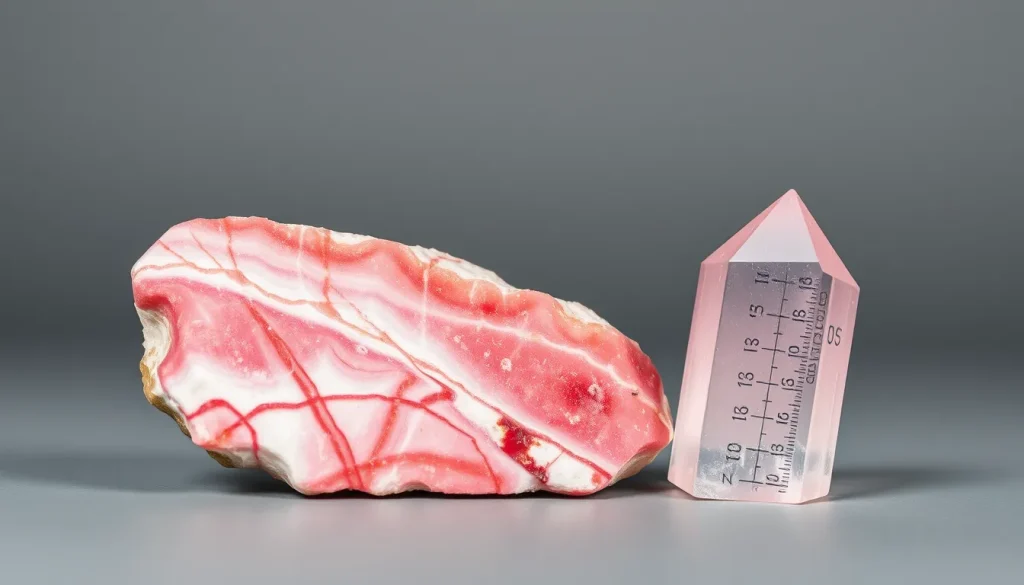
To the untrained eye, Rhodochrosite and Rose Quartz may appear similar due to their shared pink color palette. However, from a gemological perspective, they are entirely different species. One is a carbonate mineral often characterized by dramatic banding, while the other is a variety of the ubiquitous silicon dioxide (quartz). Understanding these differences is essential for proper identification, valuation, and care.
Comparison Table
| Property | Rhodochrosite | Rose Quartz |
|---|---|---|
| Chemical Formula | MnCO3 (Manganese Carbonate) | SiO2 (Silicon Dioxide) |
| Mohs Hardness | 3.5 – 4.0 | 7.0 |
| Crystal System | Trigonal | Trigonal |
| Luster | Vitreous to Pearly | Vitreous |
| Typical Appearance | Deep pink to red; often banded | Pale pink to rose; usually translucent |
| Streak | White | White |
Shared Features
The primary shared feature between Rhodochrosite and Rose Quartz is their chromatic profile. Both stones fall within the red-to-pink spectrum, which has historically associated them with themes of love, affection, and the heart. Additionally, both minerals can be found in massive forms, meaning they often occur as large chunks rather than distinct, well-formed crystals, making them popular choices for carvings and cabochons.
Important Differences
Chemical Composition and Durability
The most critical difference lies in their chemistry. Rhodochrosite is a manganese carbonate, whereas Rose Quartz is a silicate. This chemical distinction leads to a vast difference in hardness. Rose Quartz, with a Mohs hardness of 7, is significantly more durable and resistant to scratching than Rhodochrosite, which sits at a fragile 3.5 to 4. This makes Rose Quartz far more suitable for daily-wear jewelry.
Visual Identification
Rhodochrosite is famous for its “stalactitic” growth patterns, often manifesting as concentric white and pink bands (resembling agate). Its color is typically more saturated, ranging from a raspberry pink to a deep red. Rose Quartz, conversely, is generally more uniform in color, typically appearing as a soft, pale pink. While some Rose Quartz may have internal fractures or “veils,” it lacks the distinct rhythmic banding seen in high-quality Rhodochrosite.
Expert Tip: To quickly distinguish the two without professional equipment, observe the color saturation. If the stone has vivid, alternating stripes of white and pink, it is almost certainly Rhodochrosite. If it is a consistent, milky pale pink, it is likely Rose Quartz.
Suitability by Use
- Jewelry (Rings/Bracelets): Rose Quartz is the superior choice due to its hardness. Rhodochrosite is too soft for rings and is better suited for pendants or earrings.
- Collecting: Rhodochrosite is often more prized by mineral collectors for its rare crystal formations and striking banding.
- Carvings: Both are used for carvings, but Rose Quartz is easier to polish to a high gloss without risking the structural integrity of the stone.
Identification Limits
While visual cues are helpful, certain low-grade Rhodochrosite can appear pale and uniform, mimicking Rose Quartz. In such cases, a hardness test is the most reliable method: a steel nail (hardness ~5.5) will scratch Rhodochrosite but will leave Rose Quartz untouched. Additionally, Rhodochrosite will effervesce (bubble) when exposed to a weak acid, a property Rose Quartz does not possess.
Related Profiles
For those interested in pink gemstones, it is recommended to study Morganite (a pink Beryl) for high-end jewelry, Pink Tourmaline for intense color saturation, and Kunzite for its unique pleochroism.
FAQ
Can I wear Rhodochrosite in a ring?
It is not recommended for rings because its low Mohs hardness (3.5-4) makes it prone to scratching and chipping from daily activities.
How can I tell them apart if both are pale pink?
The most reliable way is a hardness test; a steel needle or knife will scratch Rhodochrosite but not Rose Quartz.
Which one is more valuable?
Generally, high-quality, deeply colored, and banded Rhodochrosite is more rare and valuable to collectors than common Rose Quartz.
Leave a Reply