
Short Answer
Overview
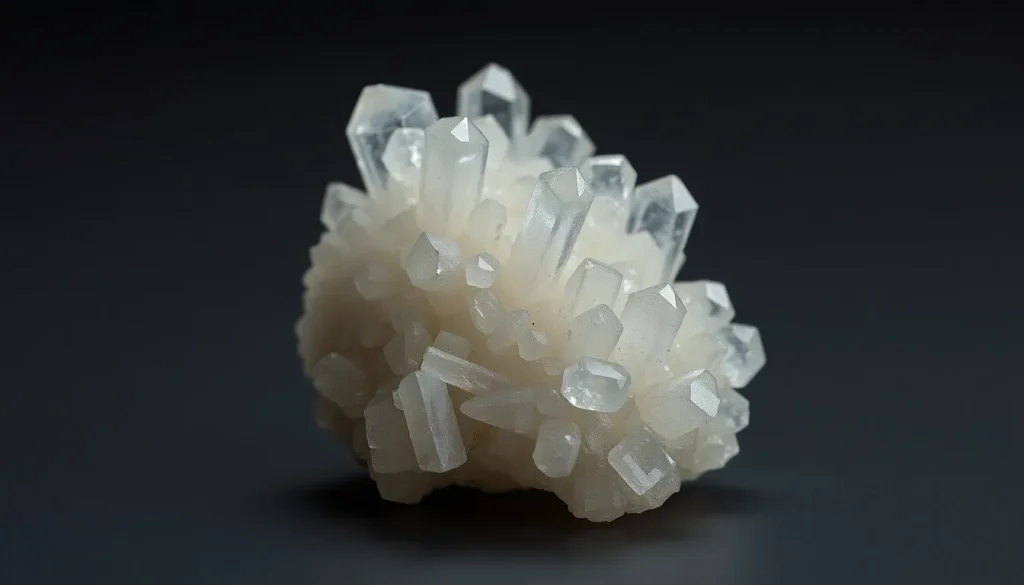
Catapleiite is a rare silicate mineral composed of sodium, zirconium, silicon, oxygen, and water molecules (Na₂ZrSi₃O₉·2H₂O). It typically appears in colorless, white, or pale‑gray tones with a vitreous to pearly luster. Crystals are usually prismatic or massive aggregates, and the stone is prized by collectors for its distinctive crystal habit and relative scarcity.
History and Origin
The name “catapleiite” derives from the Greek word katapléia, meaning “hidden” or “concealed,” a reference to the mineral’s tendency to occur in obscure, fine‑grained veins. It was first described in the early 19th century from deposits in the Ural Mountains of Russia. Since then, notable localities have been identified in Brazil (Alagoas), Madagascar, Namibia, and the Yukon Territory of Canada, where the mineral forms in alkaline pegmatites and high‑temperature hydrothermal environments.
Meaning and Symbolism
In traditional gemstone lore, catapleiite is associated with clarity of thought and the uncovering of hidden truths. Its subtle, muted coloration is thought to encourage introspection and the pursuit of inner knowledge. Collectors often view the stone as a symbol of perseverance, reflecting the way it “hides” within complex geological settings before being revealed.
Healing and Metaphysical Properties
Crystal‑healing practitioners attribute catapleiite with properties that aid mental focus and spiritual insight. It is believed to support the Crown Chakra, helping users connect with higher consciousness and enhance meditation. Some traditions claim it can assist in releasing past emotional patterns, fostering a sense of inner peace. These claims are based on folklore and are not supported by medical science.
Varieties and Types
While catapleiite is generally colorless to pale gray, minor color variations occur due to trace impurities. Light blue or pink hues have been reported in a few specimens from Madagascar. The mineral can appear as well‑formed prismatic crystals, as radiating clusters, or as massive, opaque aggregates. No widely recognized commercial varieties exist beyond these natural color variations.
Jewelry Uses and Care
Because catapleiite rates 5.5–6 on the Mohs hardness scale, it is relatively soft compared with more common gemstones such as quartz or topaz. It is therefore used sparingly in jewelry, typically in pieces that experience low impact, such as pendants, earrings, or decorative cabochons set in protective settings. Care instructions include:
- Clean with warm, soapy water and a soft brush; avoid ultrasonic cleaners.
- Do not expose to harsh chemicals, acids, or prolonged sunlight.
- Store separately in a soft pouch to prevent scratching from harder stones.
- Handle with care during setting or resizing to avoid fracture, as the mineral lacks true cleavage and may break conchoidally.
Buying Guide
When selecting catapleiite, consider the following criteria:
- Color and Transparency: Preference is usually given to colorless or lightly tinted, transparent to translucent stones.
- Clarity: Inclusions are common; choose specimens with minimal visible fractures for jewelry use.
- Cut and Setting: Well‑cut cabochons or protective bezel settings reduce the risk of damage.
- Origin: Reputable sources from Brazil, Madagascar, Namibia, or Canada are preferred. Request provenance documentation when possible.
- Certification: For higher‑value pieces, obtain a gemological report confirming the mineral identity and any treatments.
Because catapleiite is uncommon, prices can vary widely based on size, color, and clarity. Collectors may pay a premium for well‑formed crystals with rare hues.
FAQ
What is catapleiite good for?
Catapleiite is valued by collectors for its rare crystal habit and subtle colors, and it is occasionally used in jewelry that protects the stone. In crystal‑healing circles, it is believed to aid mental clarity and spiritual insight, though these claims are not scientifically verified.
Is catapleiite rare?
Catapleiite is considered rare because it forms only in specific alkaline pegmatite and hydrothermal environments. High‑quality, transparent specimens are especially scarce, making them more valuable than lower‑grade material.
How can you tell if catapleiite is real?
Real catapleiite will exhibit a Mohs hardness of 5.5–6, a vitreous to pearly luster, and a refractive index around 1.62. It lacks cleavage and shows a conchoidal fracture. Professional gemological testing, such as spectroscopy or X‑ray diffraction, is recommended for definitive identification.
What chakra is catapleiite associated with?
Traditional crystal‑healing sources associate catapleiite with the Crown Chakra, believing it helps connect the wearer to higher consciousness and spiritual insight.
How should you clean catapleiite?
Clean catapleiite gently with warm soapy water and a soft brush. Avoid ultrasonic cleaners, harsh chemicals, and prolonged exposure to sunlight. Store the stone separately in a soft pouch to prevent scratches from harder gemstones.
Leave a Reply