
Short Answer
Comparison Table
| Feature | Crystalline Aggregates | Granular Aggregates |
|---|---|---|
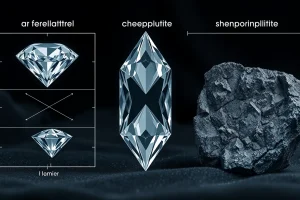
| Crystal Habit | Distinct, well-defined geometric faces | Equant, rounded, or irregular grains |
| Growth Pattern | Ordered, expansive growth (Euhedral) | Interlocking, constrained growth (Anhedral) |
| Visual Texture | Macroscopic crystals or distinct clusters | Sugar-like or sandy appearance |
Light Interaction
| Often transparent to translucent | Typically opaque to translucent |
| Example | Quartz crystals, Amethyst druse | Jasper, Quartzite, some Nephrites |
Shared Features
Despite their visual differences, both crystalline and granular aggregates are mineral aggregates—meaning they consist of a mass of mineral crystals that have grown together. Both are governed by the internal atomic arrangement of the mineral species involved. Whether a mineral forms a singular, towering crystal or a dense, granular mass, the chemical composition remains the same. Both types of aggregates can exhibit similar hardness and specific gravity, as these properties are inherent to the mineral species rather than the aggregate structure.
Important Differences
The primary distinction lies in the environment of formation and the resulting crystal habit.
Crystalline Aggregates
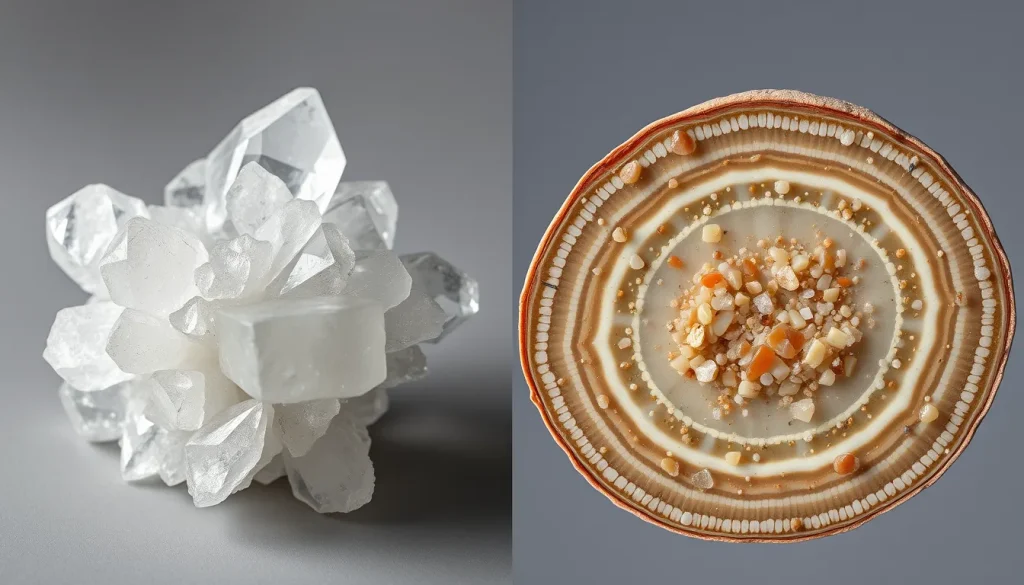
Crystalline aggregates occur when minerals have the space and time to grow without significant interference. This results in euhedral crystals, where the external faces reflect the internal symmetry of the crystal lattice. These aggregates often form in open cavities (geodes) or hydrothermal veins. When these crystals grow in a cluster, they maintain their individual geometric identities, creating a structured, often sparkling appearance.
Granular Aggregates
Granular aggregates, conversely, form under conditions of extreme spatial constraint or through metamorphic recrystallization. Because the crystals compete for space in all directions, they cannot develop distinct faces, resulting in anhedral grains. The result is a “saccharoidal” (sugar-like) texture where the mineral appears as a collection of small, interlocking grains. This structure often leads to increased opacity because light is scattered by the numerous grain boundaries.
Expert Tip: When observing a stone under a 10x loupe, look for the presence of flat, reflecting planes. If you see distinct geometric faces, you are likely dealing with a crystalline aggregate; if you see a mosaic of rounded, interlocking “blobs,” it is granular.
Suitability by Use
The structural difference significantly impacts how these materials are used in jewelry and lapidary arts:
- Crystalline Aggregates: Preferred for specimen collecting and “druzy” jewelry. Their transparency and light-reflecting properties make them ideal for faceted stones or polished clusters.
- Granular Aggregates: Highly valued for their durability and uniformity. Because they lack large cleavage planes associated with single large crystals, granular materials like Jasper or Quartzite are often tougher and better suited for carving, cabochons, and architectural ornaments.
Identification Limits
Distinguishing between the two can be challenging when the grain size in a granular aggregate is extremely fine (microcrystalline). In such cases, the stone may appear homogeneous to the naked eye. A petrographic microscope or scanning electron microscope (SEM) is often required to determine if the structure is truly granular or if it is a single crystal with high inclusion density. Furthermore, some minerals can exhibit both habits depending on the geological setting, meaning the mineral species alone cannot predict the aggregate type.
Related Profiles
To further understand these concepts, readers should examine profiles of Quartz (which exhibits both macro-crystalline and granular forms) and Jadeite/Nephrite (which are classic examples of interlocking granular/fibrous aggregates that provide immense toughness).
FAQ
Can a mineral be both crystalline and granular?
Yes. A mineral species (like Quartz) can form as large, distinct crystals in a geode (crystalline) or as a dense, interlocking mass in a metamorphic rock (granular), depending on the environment.
Which is more valuable for jewelry?
Value depends on the use. Crystalline forms are prized for transparency and brilliance, while granular forms are prized for color saturation and durability in carvings.
How do I tell them apart without a microscope?
Look for geometric faces and sharp angles. If the stone looks like it is made of tiny sand grains or has a matte, sugary surface before polishing, it is likely granular.
Leave a Reply