
Short Answer
Overview
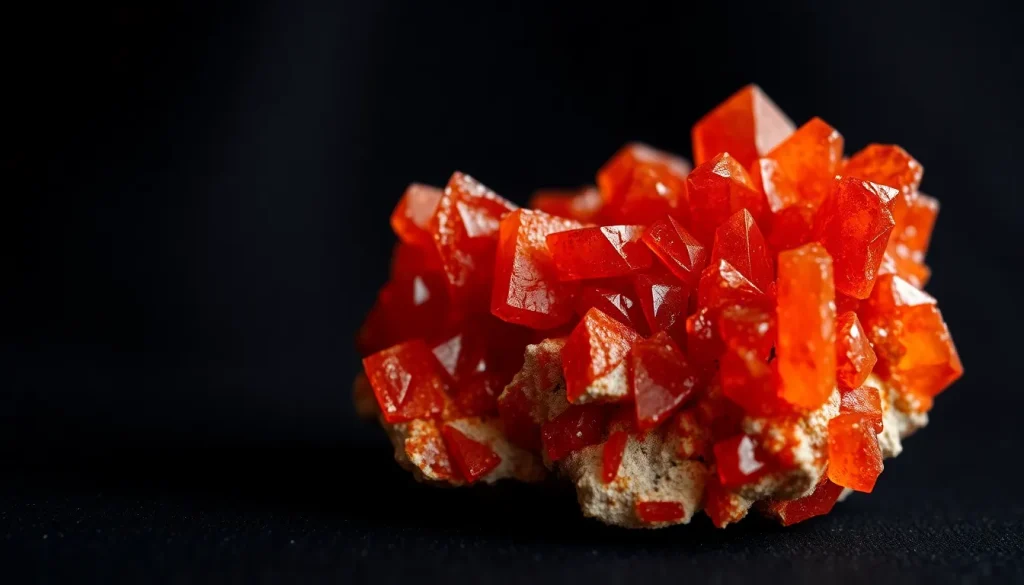
Realgar (As₄S₄) is a mineral composed of arsenic sulfide that forms striking orange‑red, sometimes deep scarlet, crystals. It belongs to the sulfide class and crystallises in the monoclinic system. Historically it was prized as a pigment (“realgar red”) and occasionally set in ornamental objects, though its low hardness and toxic arsenic content limit modern gemstone use.
History and Origin
Realgar has been known since antiquity. Ancient Chinese texts record its use as a pigment and in traditional medicine. In Europe, it was employed by alchemists and later as a component of red fireworks. Major natural occurrences are found in hydrothermal veins and as a sublimation product in volcanic fumaroles. Notable historic localities include the Hunan Province of China, the Alps of Italy and Switzerland, and the Navajo‑Hopi mining districts of Arizona, USA.
Meaning and Symbolism
In folklore and modern crystal‑healing circles, Realgar is associated with transformation, courage, and protection. Its vivid hue is said to stimulate vitality and help break through stagnation. Some traditions view it as a stone that can dispel negative energies and encourage decisive action.
Healing and Metaphysical Properties
According to crystal‑healing beliefs, Realgar is thought to:
- Amplify personal power and confidence.
- Facilitate emotional release and encourage bold decision‑making.
- Provide energetic protection against psychic attack.
These claims are not supported by scientific evidence, and Realgar should never be used as a substitute for professional medical treatment.
Varieties and Types
Realgar is sometimes confused with its metastable counterpart, pararealgar. Pararealgar forms when Realgar is exposed to light or heat over time, resulting in a yellow‑orange powder. Both share the same chemical composition but differ in crystal structure. Realgar may also occur as massive aggregates, prismatic crystals, or as fine‑grained crusts.
Jewelry Uses and Care
Because Realgar rates only 1.5–2.5 on the Mohs scale, it scratches easily and is unsuitable for everyday wear. Its toxicity (arsenic) also raises safety concerns. When used in jewelry, it is typically set in protective settings such as bezel or double‑claw mounts, and the piece is kept as a pendant or occasional accessory rather than a ring.
Care recommendations:
- Handle with gloves to avoid skin contact with dust.
- Store in a sealed, labeled container away from sunlight, as prolonged exposure can cause the stone to fade and convert to pararealgar.
- Clean gently with a soft, dry brush; avoid water, ultrasonic cleaners, or chemical solvents.
- Never wear Realgar jewelry while sleeping or during vigorous activity.
Buying Guide
When purchasing Realgar, consider the following:
- Source and authenticity: Request documentation from reputable dealers. Genuine specimens often display the characteristic monoclinic crystal habit and vivid orange‑red color.
- Treatment disclosure: Some stones are artificially dyed or stabilized. Ask if the piece has been treated or if it is a natural mass.
- Safety information: Ensure the seller provides handling instructions and confirms that the stone complies with local regulations regarding arsenic‑containing minerals.
- Setting suitability: Choose designs that protect the stone from impact and limit exposure to light.
Because Realgar is not a common gemstone, prices vary widely based on size, clarity, and provenance. High‑quality, well‑preserved crystals from classic localities can command premium prices.
FAQ
What is Realgar good for?
Realgar is valued for its intense orange‑red color, making it a historic pigment and an occasional ornamental stone. In crystal‑healing circles it is believed to boost courage and protect against negative energy, though these claims are not scientifically proven.
Is Realgar rare?
Realgar is not extremely rare in mineral form, but high‑quality, well‑preserved crystals suitable for jewelry are uncommon due to the stone’s softness, light sensitivity, and arsenic toxicity.
How can you tell if Realgar is real?
Authentic Realgar displays a bright orange‑red hue, monoclinic crystal habit, and a red‑orange streak on unglazed porcelain. Because of its toxicity, professional gemological testing and verification of source are recommended.
What chakra is Realgar associated with?
Traditional crystal‑healing sources associate Realgar with the Root (Muladhara) chakra, reflecting its red color and purported grounding energy.
How should you clean Realgar?
Clean Realgar gently with a soft, dry brush. Avoid water, ultrasonic cleaners, and chemical solvents. Store it in a sealed container away from light to prevent alteration to pararealgar.
Leave a Reply