
Short Answer
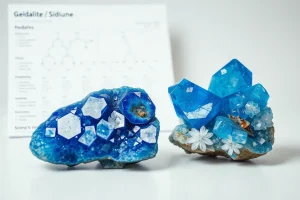
In the world of gemology, the transition from a colorless crystal to a vibrant gemstone often depends on the presence of trace elements—impurities that occupy a small fraction of the mineral’s chemical structure. Among these, copper is one of the most potent chromophores, capable of producing some of the most striking, “neon” hues found in nature, ranging from deep oceanic blues to electric greens.
Definition
In gemological terms, copper acts as a chromophore—an atom or ion that absorbs specific wavelengths of visible light and reflects others, thereby giving a gemstone its color. Unlike primary chemical components that define a mineral’s species, copper often exists as a trace element, meaning it replaces another ion (such as aluminum or magnesium) in the crystal lattice or resides in the interstices of the structure.
Plain-English Explanation
Imagine a clear piece of glass. On its own, it lets all light pass through. Now, imagine adding a tiny drop of a powerful pigment. Copper works similarly in gemstones. When copper ions enter a crystal, they create “energy gaps” that only allow certain colors of light to bounce back to your eye. Because copper is particularly efficient at absorbing red and yellow light, it reflects the opposite end of the spectrum: the vivid blues and greens. The “neon” quality often associated with copper-bearing stones comes from the intensity and saturation of these reflections, which can appear almost luminous under bright light.
Example
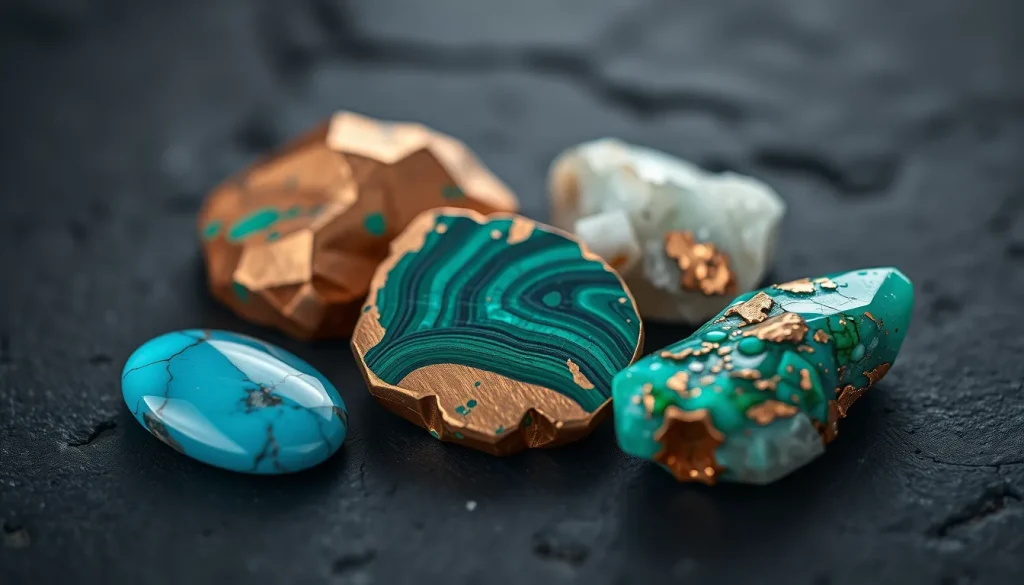
The most iconic examples of copper-driven coloration can be found in several distinct mineral groups:
- Turquoise: A phosphate mineral where copper is the primary coloring agent. The characteristic “robin’s egg blue” is a direct result of copper replacing aluminum in the structure.
- Malachite: A copper carbonate hydroxide where copper is not just a trace element but a fundamental part of the chemistry, resulting in an opaque, deep green with characteristic banding.
- Chrysocolla: A hydrated copper silicate that exhibits a range of cyan to deep blue tones.
- Diopside (Chrome-Copper): While chromium often dominates, copper can influence the saturation of greens in certain pyroxenes.
Gemologist’s Tip: When examining a blue gemstone, the presence of copper often results in a “cooler” blue compared to the “warmer” or more violet-toned blues produced by iron or manganese.
Why It Matters
Understanding the role of copper is critical for several reasons in professional gemology:
- Identification: Knowing that copper produces specific hues helps gemologists narrow down the identity of an unknown stone. For instance, a vivid blue-green phosphate is highly likely to be copper-bearing.
- Valuation: In many species, the concentration and distribution of copper determine the saturation. High-saturation “neon” colors generally command higher market prices.
- Treatment Detection: Some stones are treated to enhance copper-like colors. By understanding the natural chemistry of copper ions, experts can use spectroscopy to differentiate between a naturally copper-colored stone and one that has been artificially dyed or irradiated.
- Stability: Copper-bearing minerals can be sensitive to acids or extreme heat, which may alter the oxidation state of the copper and change the gemstone’s color.
FAQ
Can copper make a gemstone red?
Generally, no. In gemstones, copper is primarily associated with blue and green hues. Red colors are typically the result of chromium, manganese, or iron.
Is copper-colored turquoise always natural?
Not necessarily. While copper provides the natural color, some turquoise is stabilized or dyed to enhance the blue-green saturation.
Does copper affect the hardness of a gemstone?
As a trace element, copper has a negligible effect on the overall hardness of the mineral, though it defines the chemical stability of the species.

Leave a Reply