
Short Answer
Overview
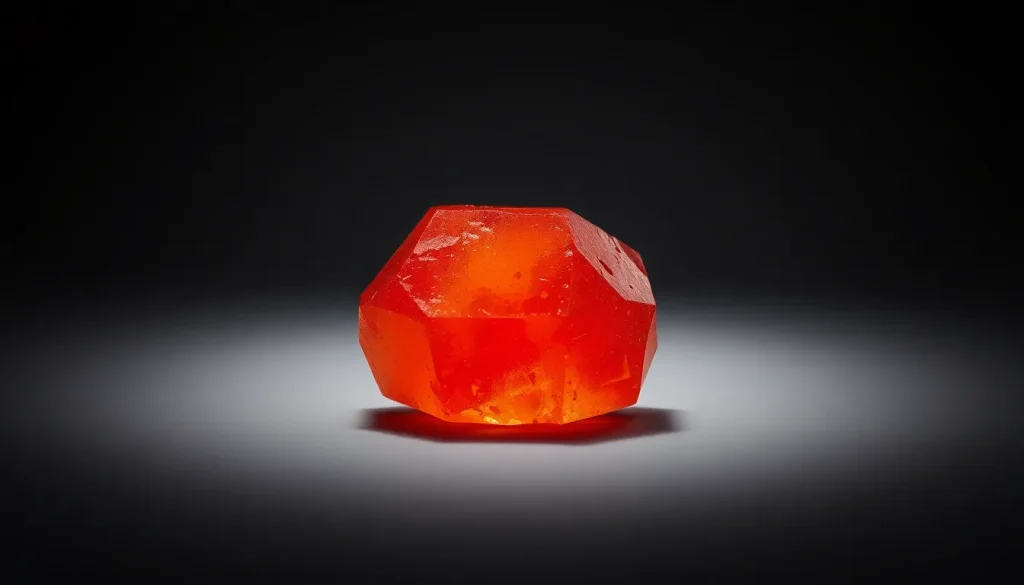
Vanadinite is a lead chlorovanadate mineral with the chemical formula Pb5(VO4)3Cl. It belongs to the apatite group and crystallizes in the hexagonal system, forming striking prismatic or tabular crystals that display vivid orange‑red to brownish‑red hues. Although primarily a mineral specimen, well‑formed, transparent crystals are occasionally cut for use in ornamental jewelry and collector pieces.
History and Origin
The name “vanadinite” was introduced in 1866 after the element vanadium was identified in the mineral by the French chemist Henri Étienne Sainte‑Claire Deville. Natural occurrences are found in oxidized zones of lead‑zinc‑vanadium ore deposits where vanadium substitutes for phosphate in the apatite structure. Notable historic localities include the historic mining districts of Zacatecas, Mexico, and the Tsumeb mine in Namibia.
Meaning and Symbolism
In traditional crystal lore, vanadinite is associated with vitality, personal power, and the encouragement of decisive action. Its vivid red color is often linked to the life‑force energy of the body, symbolizing courage, passion, and the ability to overcome obstacles. The mineral is sometimes regarded as a talisman for confidence in leadership and for manifesting goals.
Healing and Metaphysical Properties
Crystal‑healing practitioners describe vanadinite as a stone that supports the root chakra, grounding the wearer and fostering a sense of stability. It is believed to aid in resolving feelings of stagnation, promote physical endurance, and stimulate the circulatory system. These claims are based on traditional beliefs and are not a substitute for professional medical advice.
Varieties and Types
Vanadinite occurs in several visual varieties, primarily distinguished by color intensity and crystal size:
- Bright orange‑red: The most common and sought‑after hue, often displaying a clear, glassy luster.
- Brownish‑red: Slightly darker specimens that may contain inclusions of other lead minerals.
- Yellow‑orange: Rare, lighter‑colored material that can occur when vanadium content is lower.
All varieties share the same chemical composition; differences are due to trace element variations and oxidation states.
Jewelry Uses and Care
Because of its relatively low hardness (3.5–4 on the Mohs scale) and perfect cleavage, vanadinite is best suited for pendants, earrings, and brooches where the stone can be set securely without exposure to abrasion. It is often cut as cabochons to showcase its color and internal clarity.
Care instructions:
- Clean gently with a soft, lint‑free cloth. Avoid ultrasonic cleaners or harsh chemicals.
- Store separately from harder gemstones to prevent scratching.
- Protect from prolonged exposure to acids or strong bases, which can damage the surface.
Buying Guide
When selecting vanadinite, consider the following factors:
- Color saturation: Deep, uniform orange‑red is generally more valuable.
- Clarity: Look for minimal inclusions and a clear internal zone.
- Crystal habit: Well‑formed hexagonal prisms or tabular crystals are preferred for collectors.
- Treatment disclosure: Some commercial pieces are stabilized or dyed; reputable sellers will disclose any enhancements.
- Certification: For high‑value specimens, a gemological report from a recognized laboratory adds confidence.
Because vanadinite is relatively abundant in certain localities, price is primarily driven by color quality, size, and cut rather than rarity alone.
FAQ
What is vanadinite good for?
Vanadinite is prized for its vivid orange‑red color and hexagonal crystal form, making it a collector's mineral and occasional jewelry stone. Traditionally, it is believed to promote courage, grounding, and decisive action, though these are spiritual concepts, not medical treatments.
Is vanadinite rare?
Vanadinite is not extremely rare in mineral form, but high‑quality, transparent, deep‑colored crystals suitable for jewelry are less common. Rarity is linked to color saturation, crystal size, and the absence of treatments.
How can you tell if vanadinite is real?
Real vanadinite exhibits a high specific gravity (around 6), a bright orange‑red to brownish‑red color, and a hexagonal prism habit. It is relatively soft (Mohs 3.5–4) and has an adamantine luster. Professional gemological testing, such as density measurement and spectroscopic analysis, confirms authenticity.
What chakra is vanadinite associated with?
In crystal‑healing traditions vanadinite is most commonly linked to the Root (Muladhara) chakra, where it is thought to enhance grounding and stability.
How should you clean vanadinite?
Clean vanadinite gently with a soft, lint‑free cloth and mild soap if needed. Avoid ultrasonic cleaners, harsh chemicals, and prolonged exposure to acids, as the stone is relatively soft and can be damaged by abrasion or chemical attack.
Leave a Reply