
Short Answer
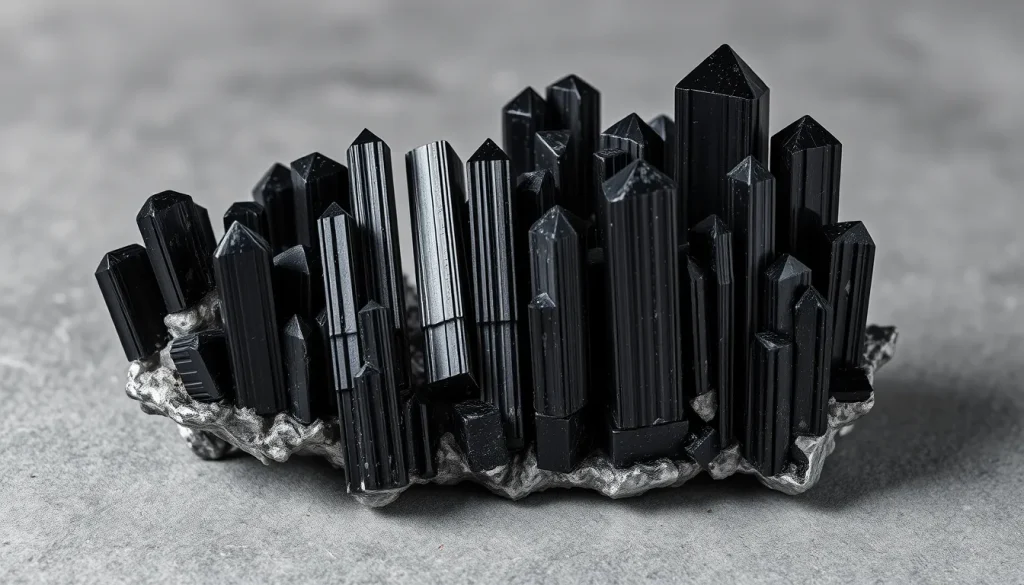
Schorl is the most abundant member of the tourmaline group, characterized by its deep black opacity and strong trigonal crystal structure. While often overshadowed by its colorful cousins like rubellite or indicolite, Schorl is a mineral of significant scientific interest and immense popularity in the metaphysical community.
What Is Schorl?
Schorl is a complex boron silicate mineral, specifically a sodium-iron-aluminum borosilicate. Chemically, it is defined by the formula NaFe₃Al₆(BO₃)₃Si₆O₁₈(OH)₄. The presence of high concentrations of iron is what gives the stone its characteristic opaque black color.
It typically forms in granitic pegmatites and is often found in elongated, striated prisms. One of its most distinctive physical properties is its pyroelectric and piezoelectric nature, meaning it can generate an electrical charge when heated or subjected to mechanical pressure.
Practical Uses and Limitations
Due to its hardness and stability, Schorl is used in various capacities, ranging from industrial to aesthetic:
- Jewelry: Used primarily in cabochons, beads, and raw crystal points. Its high luster makes it attractive when polished.
- Industrial: Historically used in pressure gauges because of its piezoelectric properties.
- Ornamental: Frequently used in home decor and as specimen pieces for mineral collectors.
The primary limitation of Schorl is its opacity; unlike other tourmalines, it cannot be used for faceted gemstones intended for brilliance or transparency. Additionally, while tough, it can be prone to cleavage along the c-axis if struck sharply.
Identification and Look-Alikes
To the untrained eye, Schorl can be mistaken for other black minerals. A senior gemologist looks for the following markers:
| Feature | Schorl (Black Tourmaline) | Black Onyx/Agate | Hematite |
|---|---|---|---|
| Crystal Habit | Striated prisms | Botryoidal/Massive | Metallic/Tabular |
| Luster | Vitreous to Resinous | Waxy to Vitreous | Metallic |
| Hardness | 7.0 – 7.5 (Mohs) | 6.5 – 7.0 (Mohs) | 5.5 – 6.5 (Mohs) |
Jewelry Suitability and Care
Schorl is highly suitable for daily wear due to its hardness. However, to maintain its luster, specific care is recommended:
Expert Tip: Avoid using ultrasonic cleaners on raw Schorl specimens, as internal fractures (common in pegmatite crystals) can expand under high-frequency vibration, potentially causing the stone to split.
- Cleaning: Use warm soapy water and a soft brush.
- Storage: Store separately from softer stones like fluorite or apatite to prevent scratching.
Symbolism and Modern Beliefs
In modern metaphysical practices, Schorl is regarded as the “Ultimate Grounding Stone.” It is believed to act as a psychic shield, protecting the wearer from negative energies and electromagnetic smog (EMF). Practitioners often place Schorl at the four corners of a room or wear it as a pendant to maintain emotional stability and focus.
FAQ
Is Black Tourmaline the same as Schorl?
Yes, Schorl is the specific mineral species of tourmaline that is iron-rich and black. While other tourmalines can be dark, 'Black Tourmaline' in trade almost always refers to Schorl.
How can I tell if my black stone is Tourmaline or Onyx?
Check the surface. Tourmaline typically has vertical striations (lines) running down the length of the crystal, whereas Onyx is usually smooth or has concentric banding.
Does Black Tourmaline actually block EMF?
While widely believed in metaphysical circles, there is no peer-reviewed scientific evidence that Schorl blocks electromagnetic frequencies in a way that impacts human health.
Leave a Reply