
Short Answer
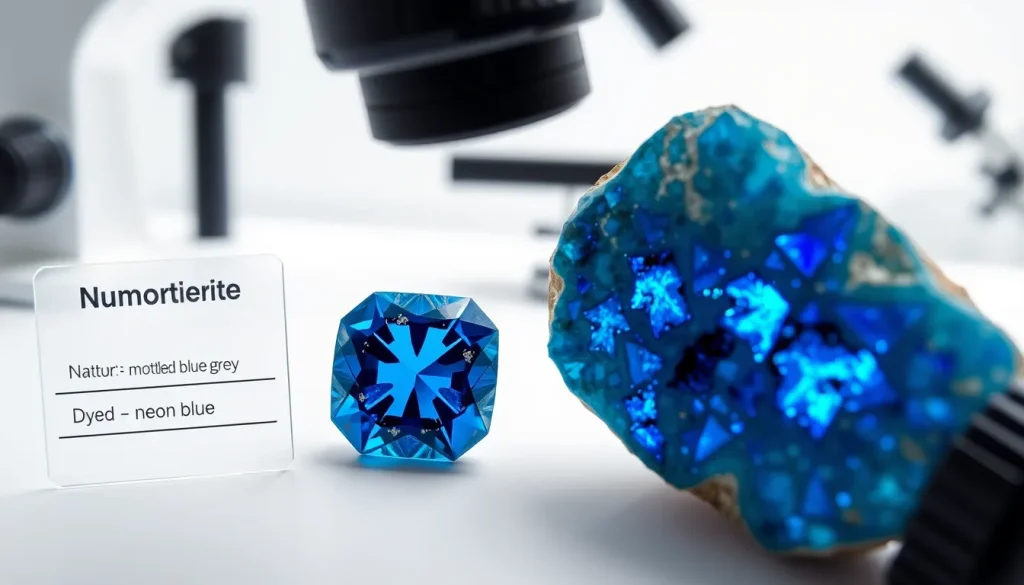
Dumortierite is a highly valued aluminum borosilicate mineral, prized for its deep, saturated blue hues. However, because the market demands intense color, some low-grade or colorless specimens are subjected to dyeing processes to mimic high-quality natural material. For the collector or jeweler, distinguishing between these two is critical for both valuation and authenticity.
Direct Answer
The primary way to identify natural versus dyed Dumortierite is by examining the distribution of color. Natural Dumortierite exhibits an inherent, integrated blue color that is often uneven or mottled (cloudy) due to the mineral’s crystalline structure. In contrast, dyed Dumortierite often displays an unnaturally uniform color or, conversely, an intense concentration of pigment in the fissures, cracks, and along the edges of the stone, where the dye has seeped into the porous structure.
Relevant Conditions
Identification becomes more complex depending on the quality of the dyeing process and the original state of the stone. Consider the following conditions:
- Low-Grade Base Material: Most dyed Dumortierite starts as a pale or greyish silicate. If the blue is too “perfect” or lacks the characteristic grey-blue depth, suspicion is warranted.
- Surface Finish: High-gloss polishes can sometimes mask surface-level dye accumulation, making visual inspection more difficult.
- Lighting Environment: Natural Dumortierite maintains its hue under various light sources, whereas some synthetic dyes may shift or appear “flat” under strong UV or incandescent light.
Recommended Steps
To accurately determine the authenticity of the color, follow these systematic gemological steps:

- Visual Inspection (Macro): Use a 10x jeweler’s loupe to examine the stone’s surface. Look for “color bleeding”—intense blue lines tracing the internal fractures. In natural stones, fractures are typically colorless or contain mineral inclusions, not concentrated pigment.
- Observation of Color Zoning: Analyze the color distribution. Natural Dumortierite often has a “splotchy” or variegated appearance. If the stone is a monolithic, saturated blue without any natural variation, it is a red flag.
- The Solvent Test (Non-Destructive): While not always definitive, gently rubbing a small, inconspicuous area with an acetone-soaked cotton swab can sometimes reveal surface-level dyes.
Expert Tip: Always test a tiny area on the back or girdle of the stone to avoid damaging the primary face of the gemstone.
- Microscopic Analysis: Under higher magnification, look for dye molecules trapped in the micro-voids of the crystal. Natural color is part of the crystal lattice; dye is a foreign substance sitting in the gaps.
Exceptions
There are rare cases where natural Dumortierite may appear deceptively uniform due to high purity, or conversely, where natural impurities create patterns that look like dye seepage. Specifically:
- High-Grade Specimens: Rare, top-tier natural Dumortierite can be very saturated, which may lead beginners to suspect dyeing.
- Natural Inclusions: Some natural stones have dark mineral inclusions that can be mistaken for dye spots if the observer is not familiar with the mineral’s typical habit.
When to Ask a Professional
If the stone is of high value or intended for a significant investment, home testing is insufficient. You should seek a certified gemologist when:
- The stone shows a “perfect” color that seems too good to be true.
- You require a formal certificate of authenticity for resale.
- The stone has been heavily treated with resins or polymers in addition to dye, which requires Spectroscopic Analysis (FTIR) or EDX to identify the chemical composition of the colorant.
FAQ
Can dyed Dumortierite fade over time?
Yes, artificial dyes are often less stable than natural mineral coloration and may fade when exposed to prolonged sunlight or harsh chemicals.
Is dyed Dumortierite worthless?
Not necessarily, but its value is significantly lower than natural, high-grade Dumortierite. It is typically sold as decorative or costume jewelry.
Does a 'natural' certificate always guarantee it isn't dyed?
A certificate of 'natural origin' means the stone is Dumortierite, but it may not specify 'untreated.' Always look for the specific phrase 'no indications of treatment'.
Leave a Reply