
Short Answer
Overview
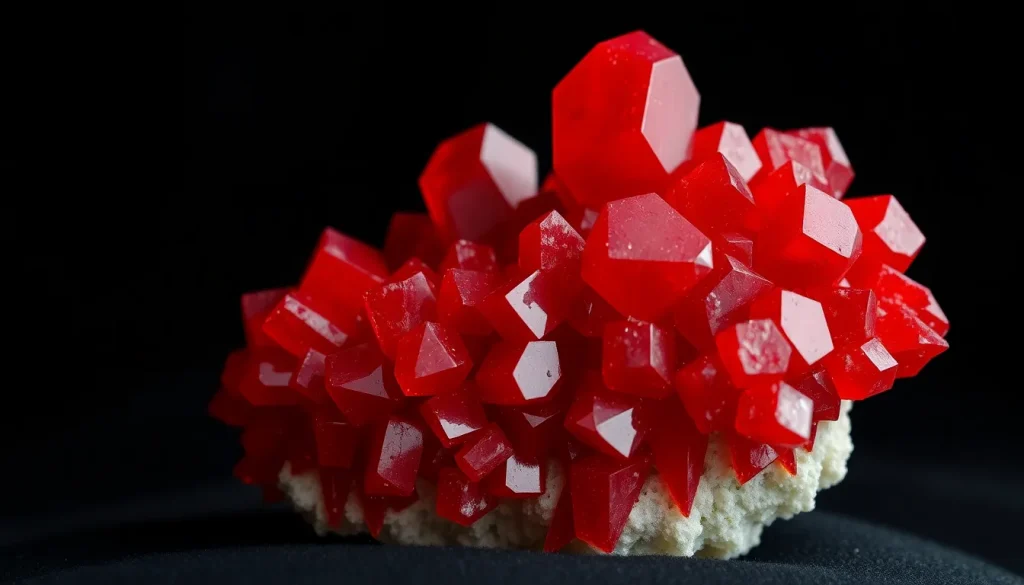
Cinnabar is a naturally occurring mercury sulfide mineral renowned for its intense scarlet to orange‑red hue. Crystallizing in the trigonal system, it forms rhombohedral clusters or massive granular masses. With a Mohs hardness of 2–2.5 and a high specific gravity around 8.1, cinnabar is relatively soft and heavy, making it suitable for carving, inlay work, and as a pigment source rather than for everyday jewelry.
History and Origin
The name “cinnabar” derives from the ancient Greek kinnabari, itself borrowed from Persian. Historically it was mined in the Almadén district of Spain, one of the world’s largest mercury sources, and later in China, Italy, and the United States. The mineral has been ground to produce the vivid red pigment vermilion, used in prehistoric cave art, classical frescoes, and illuminated manuscripts. Because of its mercury content, cinnabar was also associated with alchemy and early medicinal practices, although modern science recognizes its toxicity.
Meaning and Symbolism
In traditional gemstone lore, cinnabar’s bright red is linked to life force, passion, and courage. It is said to embody the fire of transformation, symbolising rebirth and the shedding of old patterns. Cultures that used cinnabar as a pigment often associated it with royalty, power, and protection.
Healing and Metaphysical Properties
Crystal‑healing practitioners describe cinnabar as a stone that stimulates the root chakra, promoting grounding, stability, and a sense of personal security. It is also connected to the solar plexus chakra, where it is believed to boost confidence, vitality, and personal power. Traditional beliefs suggest cinnabar can aid in emotional balance, encourage decisive action, and support the body’s circulation. These claims are not medical facts and should not replace professional health advice.
Varieties and Types
Pure cinnabar is uniformly bright red, but variations occur due to impurity or weathering:
- Bright Red Cinnabar – The classic scarlet hue most valued for ornamental carving.
- Brownish Cinnabar – Often the result of oxidation, producing a duller, chocolate‑brown surface.
- Synthetic Vermilion – Man‑made pigment that mimics natural cinnabar’s color but lacks the mineral’s crystal structure.
Jewelry Uses and Care
Because of its softness, cinnabar is generally used in low‑impact jewelry such as pendants, cabochons, or inlay pieces set within harder metals. It is also popular in decorative objects, rosaries, and collector’s carvings. Care considerations include:
- Avoid scratching – use only soft cloths and gentle handling.
- Protect from acids and heat – cinnabar can release mercury vapor when heated or exposed to strong acids.
- Store separately – keep away from harder gemstones to prevent abrasion.
- Cleaning – wipe with a dry or slightly damp soft cloth; never submerge in water or use ultrasonic cleaners.
Buying Guide
When purchasing cinnabar, consider the following factors:
- Color Saturation – Deep, uniform red indicates higher quality.
- Clarity – Clear, fracture‑free surfaces are preferred for polishing.
- Origin Documentation – Reputable dealers will provide provenance, especially for specimens from historic mines.
- Treatment Disclosure – Ensure the stone is natural and not dyed or artificially enhanced.
- Safety Information – Verify that the seller informs about the mineral’s mercury content and provides handling guidelines.
FAQ
What is cinnabar good for?
Cinnabar is valued for its intense red color, historically used as the pigment vermilion, in decorative inlays, carvings, and low‑impact jewelry. In crystal‑healing traditions it is believed to promote grounding, vitality, and emotional courage.
Is cinnabar rare?
Cinnabar occurs in several major localities worldwide, but high‑quality, vivid‑red material is less common. Large, clear crystals are rarer than massive granular specimens, and untreated natural stone is less frequently found on the market.
How can you tell if cinnabar is real?
Real cinnabar displays a characteristic scarlet to orange‑red color, high specific gravity (feels heavy for its size), and a conchoidal fracture. It lacks the glassy shine of synthetic vermilion. Professional gemologists use spectroscopy or X‑ray diffraction for definitive identification.
What chakra is cinnabar associated with?
Traditional crystal‑healing systems associate cinnabar primarily with the Root (Muladhara) chakra for grounding, and also with the Solar Plexus (Manipura) chakra for personal power and confidence.
How should you clean cinnabar?
Because cinnabar is soft and contains mercury, clean it with a dry or slightly damp soft cloth. Avoid ultrasonic cleaners, harsh chemicals, or prolonged exposure to water. Store it separately from harder gems to prevent scratches.
Leave a Reply