Short Answer
Overview
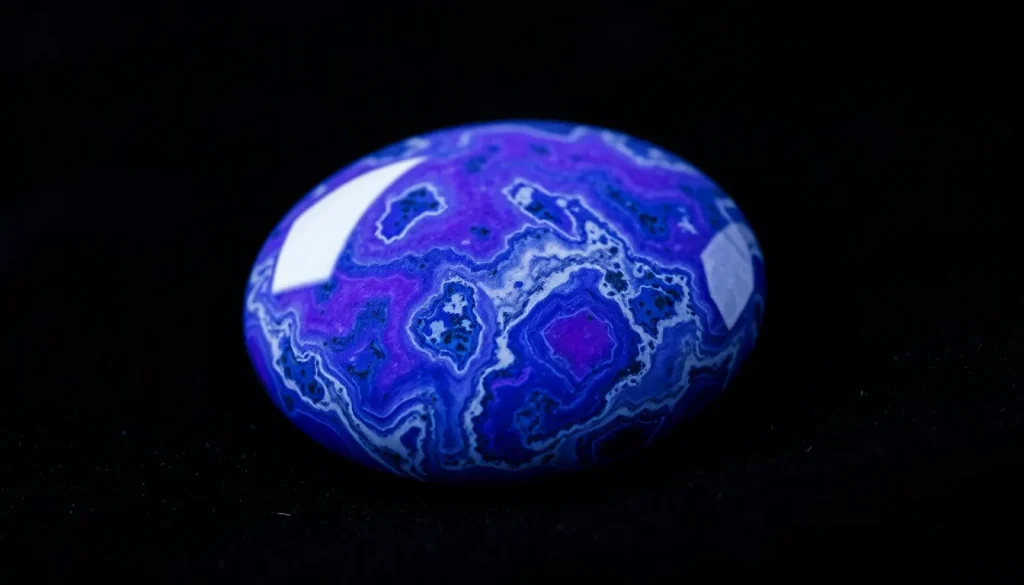
Charoite is a rare mineral belonging to the zoisite group, recognized for its vivid violet‑blue to lilac color and characteristic swirling, fibrous matrix. It is primarily found in the Murun Massif of eastern Siberia, Russia. With a Mohs hardness of 5.5–6.5, it is used in cabochons, beads, and high‑end ornamental pieces.
History and Origin
The stone was first identified in 1978 during geological surveys of the Chara River basin, which gave it its name. Until the early 1990s it remained virtually unknown outside scientific circles. Its striking appearance quickly attracted the attention of gem dealers, and it entered the international market as a luxury ornamental stone.
Meaning and Symbolism
In traditional gemstone lore, charoite is associated with transformation and spiritual awakening. Its swirling patterns are said to symbolize the flow of energy and the journey from darkness to light, making it a popular talisman for personal growth.
Healing and Metaphysical Properties
Crystal‑healing practitioners claim that charoite supports the heart and mind by encouraging emotional balance, enhancing intuition, and fostering a sense of inner peace. It is often linked to the third‑eye and crown chakras, aiding meditation and spiritual insight. These claims are based on tradition and should not replace professional medical advice.
Varieties and Types
- Raw crystal – uncut specimens displaying natural mass‑like formations.
- Polished cabochon – most common in jewelry, highlighting the stone’s swirling color.
- Heat‑treated – rare treatments are reported to intensify violet tones, though most charoite on the market is natural.
Jewelry Uses and Care
Because of its moderate hardness, charoite is best set in protective settings such as bezel or channel settings that shield the surface from scratches. It is suitable for earrings, pendants, and statement rings, but should be avoided for high‑impact items like watch cases.
Cleaning: Use warm, soapy water and a soft brush. Avoid ultrasonic cleaners and harsh chemicals, which can damage the surface or any applied treatments.
Buying Guide
- Verify origin – reputable dealers will disclose Siberian provenance.
- Examine color – genuine charoite shows a deep violet base with white‑gray veining; overly uniform color may indicate imitation.
- Check for treatments – ask if the stone has been heat‑treated or dyed.
- Request certification – a gemological report from GIA or a recognized laboratory confirms authenticity.
- Consider setting – choose protective settings to preserve the stone’s surface.
FAQ
What is charoite good for?
Charoite is valued for its striking violet‑blue appearance in jewelry and ornamental objects. Traditionally, it is believed to support spiritual transformation and emotional balance, but these uses are based on metaphysical traditions, not scientific evidence.
Is charoite rare?
Charoite is considered rare because it is found in only one major locality in Siberia. High‑quality, deep‑violet material with minimal veining is especially scarce, while lower‑grade material is more available.
How can you tell if charoite is real?
Real charoite displays a vivid violet base with white‑gray swirls and a vitreous luster. It has a Mohs hardness of 5.5–6.5 and a specific gravity around 3.0. Professional testing, such as refractive index measurement or a gemological report, provides certainty.
What chakra is charoite associated with?
In crystal‑healing traditions, charoite is linked to the Third Eye and Crown chakras, where it is said to enhance intuition and spiritual connection.
How should you clean charoite?
Clean charoite with warm soapy water and a soft brush. Avoid ultrasonic cleaners, steam, or harsh chemicals, and store the stone away from harder materials to prevent scratches.
Leave a Reply