Short Answer
Overview
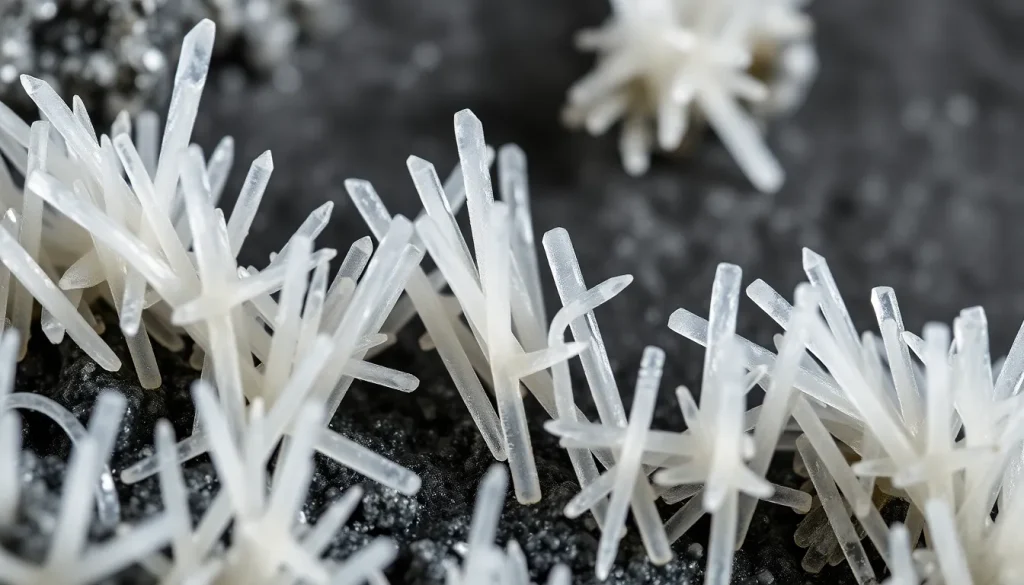
Ettringite is a hydrous calcium‑aluminium sulfate mineral with the formula Ca6Al2(SO4)3(OH)12·26H2O. It crystallises in the trigonal system, forming slender, acicular (needle‑like) aggregates that are typically white, colourless, or very pale gray. With a Mohs hardness of 2–2.5, Ettringite is soft and fragile, making it unsuitable for most jewelry applications but prized by mineral collectors.
History and Origin
The mineral was first described in 1827 after being discovered in the village of Ettringen near Koblenz, Germany – the namesake locality that gave Ettringite its name. Subsequent occurrences have been reported from volcanic fumaroles, limestone caves, and weathered concrete where it forms as a secondary mineral in sulfate‑rich environments.
Meaning and Symbolism
In traditional crystal‑healing circles, Ettringite is associated with clarity of thought and the release of emotional blockages. Its delicate, porous structure is said to symbolize openness and the ability to let go of stagnant energies, encouraging personal growth and renewal.
Healing and Metaphysical Properties
Believers attribute the following metaphysical qualities to Ettringite:
- Emotional balance: Helps to dissolve feelings of grief and disappointment.
- Intellectual clarity: Supports focus during study or meditation.
- Spiritual cleansing: Thought to assist in clearing energetic fields of negativity.
These claims are based on traditional beliefs and are not medical advice.
Varieties and Types
Ettringite occurs naturally in several settings, and a synthetic form is produced industrially as a component of Portland cement. The mineral belongs to the “ettringite group,” which includes related sulfate minerals such as:
- Thaumasite – a calcium silicate‑sulfate that forms in cold, wet conditions.
- Friedrichite – a rare aluminium‑rich analogue.
Natural specimens are typically found as fine, transparent needles, while synthetic ettringite appears as fine powders used in construction.
Jewelry Uses and Care
Because of its low hardness and perfect cleavage, Ettringite is rarely set in fine jewelry. When used, it is usually incorporated as a decorative accent in beaded or pendant designs where the stone is protected behind a clear protective setting. Care recommendations include:
- Handle gently; avoid any impact or pressure.
- Clean with a soft, dry brush or a lightly damp cloth; do not soak.
- Store in a padded compartment away from harder gemstones that could scratch it.
Buying Guide
When purchasing Ettringite, consider the following factors:
- Origin: Reputable dealers should disclose the locality (e.g., Ettringen, Germany; Norway; Arizona, USA).
- Appearance: Look for well‑formed, transparent needles with minimal surface alteration.
- Treatment: Natural Ettringite is rarely treated; synthetic material is usually sold for industrial use, not as a gemstone.
- Certification: Request a mineralogical report or provenance documentation, especially for high‑value collector pieces.
Because the stone is soft and water‑sensitive, verify that the seller offers guidance on handling and long‑term storage.
FAQ
What is Ettringite good for?
Ettringite is valued by collectors for its delicate needle crystals and by crystal‑healing practitioners for its traditional associations with emotional release and mental clarity. It has no practical industrial use as a gemstone due to its softness.
Is Ettringite rare?
Natural Ettringite is relatively uncommon and typically found in limited localities. High‑quality, well‑formed specimens are rarer than low‑grade material, but synthetic ettringite is abundant in the cement industry.
How can you tell if Ettringite is real?
Authentic Ettringite displays fine, transparent needles, a white streak, and a low hardness (2–2.5). A professional gemological lab can confirm its composition with X‑ray diffraction or infrared spectroscopy.
What chakra is Ettringite associated with?
In crystal‑healing belief systems, Ettringite is sometimes linked to the Crown chakra for its purported ability to clear mental fog, though no single standard association exists.
How should you clean Ettringite?
Because it is soft and water‑sensitive, clean Ettringite gently with a soft dry brush or a slightly damp cloth. Avoid ultrasonic cleaners, harsh chemicals, or prolonged soaking.
Leave a Reply