
Short Answer
Overview
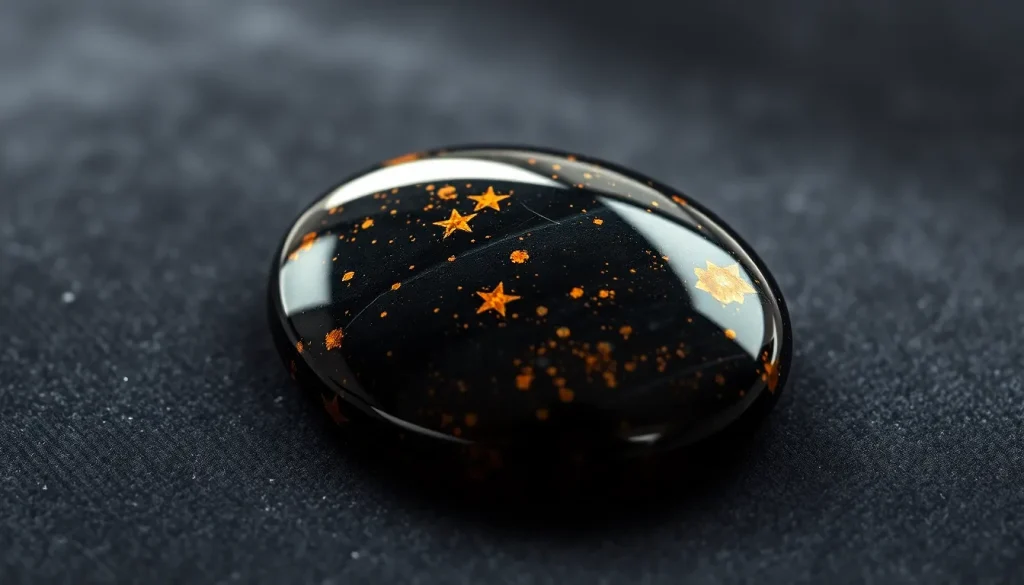
Astrophyllite is a complex, dark‑colored silicate mineral belonging to the astrophyllite group. It is most notable for its distinctive, radiating, star‑shaped crystal aggregates that often form in thin, flaky plates. The stone exhibits a submetallic to vitreous luster and ranges in color from deep brown and black to golden‑brown or reddish‑brown hues. With a Mohs hardness of 5–6, it is relatively soft for a gemstone and is therefore used primarily in cabochons, inlays, and artistic pieces rather than as a durable faceted gem.
History and Origin
The name “astrophyllite” derives from the Greek words astron (star) and phyllon (leaf), a reference to its star‑shaped crystal habit. The mineral was first described in 1815 from specimens found in the Kola Peninsula of Russia. Subsequent discoveries have been reported from Finland, Sweden, Canada (Yukon), and isolated localities in the United States (California). Because the mineral forms in high‑temperature, manganese‑rich metamorphic environments, it is typically associated with skarn deposits and altered granitic bodies.
Meaning and Symbolism
In traditional crystal‑healing circles, astrophyllite is said to carry protective and grounding energies. Its dark, star‑like appearance is thought to symbolize inner guidance, helping the wearer navigate difficult decisions. The stone is also linked to transformation, as the complex chemistry of the mineral is believed to mirror personal evolution and the shedding of old patterns.
Healing and Metaphysical Properties
Claims about astrophyllite’s metaphysical effects are based on folklore and contemporary crystal‑healing practice, not on scientific evidence. Practitioners commonly attribute the following properties to the stone:
- Protection: Supposed to shield against negative energies and psychic attack.
- Grounding: Believed to anchor the wearer’s aura to the Earth, fostering stability.
- Transformation: Said to support personal growth and the release of outdated habits.
- Spiritual Insight: Associated with the activation of the third‑eye and crown chakras, encouraging intuitive clarity.
These attributes are part of traditional belief systems and should not be interpreted as medical advice.
Varieties and Types
Astrophyllite occurs in several compositional varieties, most of which differ only slightly in the proportion of manganese, iron, titanium, and niobium. The most commonly encountered forms are:
- Standard Astrophyllite: Dark brown to black with golden‑brown speckles.
- Golden Astrophyllite: Displays a more pronounced golden‑brown hue, often prized by collectors.
- Niobium‑rich Astrophyllite: Slightly higher niobium content, giving a subtly different optical response.
All varieties share the same crystal system (monoclinic) and overall habit, but subtle color variations can affect their desirability in jewelry.
Jewelry Uses and Care
Because of its moderate hardness and perfect cleavage on one plane, astrophyllite is best suited for:
- Cabochons set in bezel or bezel‑back settings.
- Inlays in metalwork, where the stone is protected from direct impact.
- Artistic pieces such as pendants, earrings, and ornamental beads.
Cleaning: Use a soft, lint‑free cloth to gently wipe away dust. Avoid ultrasonic cleaners and harsh chemicals, as they can degrade the surface and exacerbate cleavage. For stubborn grime, a mild soap solution and a soft brush may be used, followed by thorough rinsing with distilled water and air‑drying.
Storage: Store each piece separately in a padded compartment or wrapped in a soft cloth to prevent scratching or chipping.
Buying Guide
When purchasing astrophyllite, consider the following criteria:
- Color and Luster: Deep, uniform coloration with a bright submetallic sheen is most valued.
- Clarity: Look for specimens free of heavy surface fractures; internal inclusions are common but should not compromise structural integrity.
- Cut: Cabochons that showcase the star‑shaped crystal habit are preferred. Avoid overly thin slices that may break easily.
- Origin: Provenance from classic localities (Finland, Kola Peninsula) can add value.
- Certification: Request a gemological report from a reputable laboratory (e.g., GIA, IGI) to verify authenticity and to disclose any treatments.
Because astrophyllite is not commonly treated, the primary concerns are natural color, structural soundness, and the quality of the cut.
FAQ
What is astrophyllite good for?
Astrophyllite is valued for its unique star‑shaped crystal habit in specialty jewelry and as a collector’s mineral. In crystal‑healing traditions it is believed to provide protection, grounding, and support personal transformation, though these claims are not medically verified.
Is astrophyllite rare?
High‑quality astrophyllite is considered rare due to its limited occurrence in a few localities and the difficulty of obtaining specimens with good color, luster, and structural integrity. Fine‑cut cabochons are especially scarce.
How can you tell if astrophyllite is real?
Real astrophyllite displays a dark brown to black color with a submetallic sheen, distinct cleavage, and a brownish‑black streak. Its hardness (5–6) means it can be scratched by quartz but not by a fingernail. Professional gemologists can confirm authenticity with refractive index, specific gravity, and X‑ray diffraction testing.
What chakra is astrophyllite associated with?
In crystal‑healing belief systems astrophyllite is most commonly linked to the Crown Chakra, and some traditions also associate it with the Third Eye chakra, reflecting its reputed ability to enhance spiritual insight.
How should you clean astrophyllite?
Clean astrophyllite with a soft, lint‑free cloth. For stubborn dirt, use a mild soap solution and a soft brush, then rinse with distilled water and air‑dry. Avoid ultrasonic cleaners, harsh chemicals, and extreme heat, as the stone’s perfect cleavage makes it vulnerable to chipping.
Leave a Reply