
Short Answer
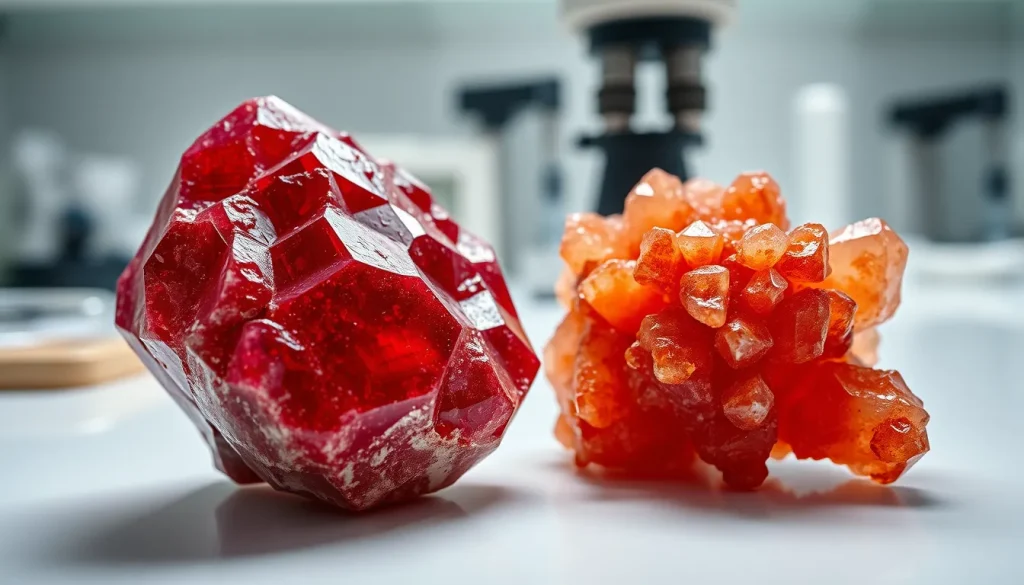
Cuprite, a stunning deep-red copper oxide, is highly prized by mineral collectors for its intense color and adamantine luster. However, the emergence of lab-grown copper oxides has created a need for rigorous identification protocols to ensure authenticity and value.
Comparison Table
| Feature | Natural Cuprite | Synthetic Copper Oxide |
|---|---|---|
| Crystal Habit | Octahedral, massive, or botryoidal | Often overly uniform or rounded grains |
| Inclusions | Natural fluid inclusions, mineral growths | Gas bubbles or lack of internal structures |
Luster
| Strong Adamantine to Metallic | Often slightly more vitreous or dull |
| Color Zoning | Natural gradients and variations | Uniform, monochromatic saturation |
| RI Value | Consistent with Cu2O standards | May deviate slightly based on process |
Shared Features
Both natural cuprite and its synthetic counterparts share the same basic chemical composition: Cu2O. Because they are chemically identical, they both exhibit the characteristic deep red to brownish-red hue. Both materials possess a relatively low hardness (approximately 3.5 to 4 on the Mohs scale) and demonstrate a high refractive index, which gives them their signature brilliance.
Important Differences
The primary distinctions lie in the morphology and internal characteristics of the specimen.
Crystal Growth and Morphology
Natural cuprite typically forms in octahedral crystals or occurs in massive, botryoidal (grape-like) aggregates. In contrast, synthetic copper oxides often exhibit a “sugary” texture or perfectly uniform grains that lack the complex geometric growth patterns found in nature.
Internal Inclusions
Under high magnification, natural cuprite often contains microscopic inclusions of other copper minerals like malachite or azurite. Synthetics, particularly those created via chemical vapor deposition or melt processes, frequently contain tiny, perfectly spherical gas bubbles which are a hallmark of laboratory origin.
Expert Tip: Always examine the contact points between crystals. Natural specimens show irregular, organic growth intersections, whereas synthetics often appear fused or unnaturally symmetrical.
Suitability by Use
- Collector Specimens: Natural cuprite is the only acceptable material for serious mineral collections. Its value is derived from its geological rarity and crystal perfection.
- Industrial Applications: Synthetic copper oxides are preferred for semiconductors and chemical catalysts due to their purity and consistency.
- Decorative Arts: For low-cost decorative items where authenticity is not a priority, synthetics may be used, though they lack the investment value of natural minerals.
Identification Limits
Visual inspection alone is rarely sufficient for a 100% certain identification, especially with high-quality synthetics. While the adamantine luster is a strong indicator of cuprite, it does not distinguish between natural and lab-grown versions. Advanced tools such as FTIR (Fourier-Transform Infrared Spectroscopy) or EDX (Energy Dispersive X-ray Spectroscopy) may be required to detect trace elements that are present in natural ores but absent in pure lab-grown oxides.
Related Profiles
For those interested in red oxides and copper-based minerals, it is recommended to study the profiles of Hematite (for color comparison) and Malachite (as a common associate mineral of natural cuprite).
FAQ
Can I identify synthetic cuprite with a handheld loupe?
While a loupe can reveal unnatural growth patterns or air bubbles typical of synthetics, a definitive identification often requires a refractometer or spectroscopic analysis.
Is synthetic cuprite common in the jewelry market?
It is more common in industrial applications or as low-cost collectibles; however, synthetic copper oxides are occasionally sold as 'natural' to unsuspecting collectors.
Does cuprite change color over time?
Natural cuprite is generally stable, though it can weather into malachite or azurite over geological timescales.
Leave a Reply