
Short Answer
Direct Answer
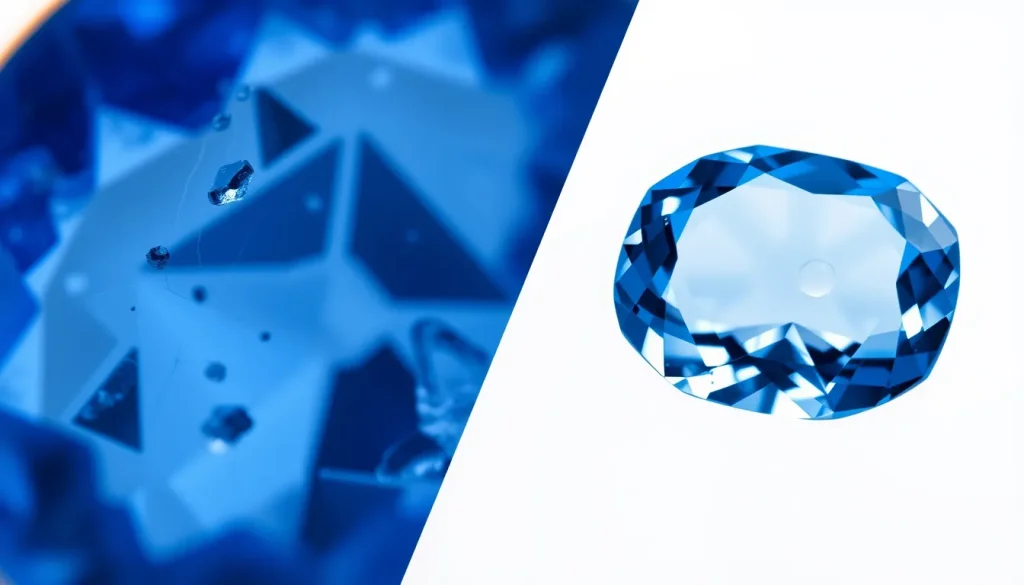
Identifying the difference between a natural sapphire and a synthetic sapphire involves analyzing the internal growth structures and inclusions of the gemstone. While both are chemically identical (aluminum oxide with trace elements), natural sapphires contain “fingerprints” of the earth’s geological processes, whereas synthetic sapphires exhibit patterns characteristic of laboratory growth, such as curved striae or gas bubbles. The most reliable method for a non-professional is to look for a total absence of inclusions, which is a strong red flag for a synthetic stone, though definitive confirmation requires a microscope or spectroscope.
Relevant Conditions
Identification becomes complex depending on the method used to create the synthetic stone. There are three primary conditions to consider:
- Flame Fusion (Verneuil): The most common and cheapest method. These stones often have curved growth lines and small gas bubbles.
- Flux Growth: A more sophisticated method that mimics natural growth. These can be very difficult to distinguish and may contain “flux fingerprints.”
- Czochralski Process: Used for high-quality industrial and jewelry stones, often resulting in a very clean, homogeneous appearance.
Expert Tip: Never rely on a “stone tester” alone. Most testers measure refractive index or thermal conductivity, which will identify both natural and synthetic sapphires as “sapphire” because they are chemically the same material.
Recommended Steps
To identify a sapphire, follow this systematic gemological approach:
- Visual Inspection (10x Loupe): Examine the stone for inclusions. Natural sapphires typically contain tiny crystals (like rutile) or “silk.” Synthetic stones are often too perfect.
- Search for Curved Striae: Using a microscope, look for curved growth lines (striae) that arc across the stone. This is a definitive sign of the Flame Fusion process.
- Check for Gas Bubbles: Look for tiny, spherical bubbles. Natural sapphires never contain gas bubbles; their presence confirms a synthetic origin.
- Analyze Color Zoning: Natural sapphires often have uneven color distribution (color zoning). Synthetic stones frequently have a very uniform, “flat” color throughout.
- Verify the Cut: Look for “over-cutting” or unnatural facet junctions, which are common in mass-produced synthetic gems.
Exceptions
Certain natural sapphires can mimic synthetic traits, and vice versa:
- High-Quality Natural Stones: Rare, “internally flawless” natural sapphires exist. Their lack of inclusions does not automatically make them synthetic, though they are extremely valuable and rare.
- Flux-Grown Synthetics: These can contain straight growth lines and mineral inclusions that look remarkably like natural crystals, often requiring a spectroscope to identify.
- Simulants: Be careful not to confuse synthetics (chemical copies) with simulants (like cubic zirconia or glass). Simulants have different physical properties and can be identified via basic refractive index tests.
When to Ask a Professional
You should seek a certified gemologist (GIA, FGA, or equivalent) in the following scenarios:
- High-Value Transactions: When purchasing an investment-grade sapphire, a laboratory report is essential.
- Presence of “Silk”: While silk usually indicates a natural stone, some advanced synthetics can mimic this effect.
- Suspected Heat Treatment: A professional can determine if a natural sapphire has been heat-treated to enhance color, which significantly affects its market value.
- Conflict-Free Certification: If you require proof of origin (e.g., Madagascar vs. Sri Lanka), only a professional lab can provide a geographical origin report.
FAQ
Can a diamond tester tell if a sapphire is synthetic?
No. A diamond tester measures thermal or electrical conductivity. Since natural and synthetic sapphires are both corundum, the tester cannot distinguish between them.
Are synthetic sapphires worth anything?
They have very little resale value compared to natural sapphires. They are valued primarily for their aesthetic appeal in costume jewelry or industrial applications.
Is a lab-grown sapphire the same as a fake?
Technically, it is not a 'fake' because it is chemically and physically a sapphire. However, it is 'synthetic' rather than 'natural,' which is why it is significantly less valuable.
Leave a Reply